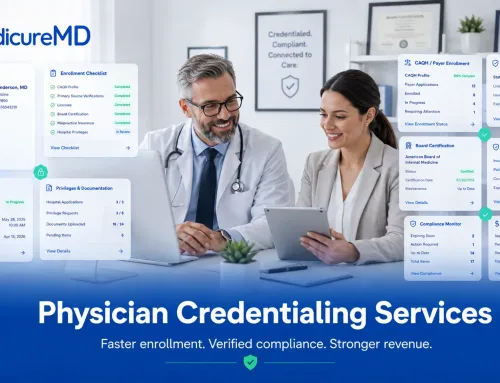

As a mental health professional, your primary focus is helping your clients heal, grow, and navigate life’s challenges. However, if you are looking to grow your private practice or clinic, you quickly run into a major administrative hurdle: insurance panels.
To accept insurance and get reimbursed for your invaluable work, you must navigate the complex, often frustrating world of insurance credentialing. That is where professional credentialing services come in, allowing you to hand off the paperwork and focus entirely on patient care.
Schedule an Appointment
Why Mental Health Providers Need Specialized Credentialing
The demand for mental health services across the United States has never been higher. Yet, many therapists, counselors, psychiatrists, and psychologists remain out-of-network simply because the onboarding process with major insurance carriers is too overwhelming.
When you utilize dedicated credentialing services for mental health providers, you open the doors to a massive pool of insured patients who otherwise could not afford out-of-pocket care.
However, mental health credentialing isn’t a one-size-fits-all process. Behavioral health billing codes, state-specific licensure requirements, and provider types (such as LCSWs, LMFTs, LPCs, or PsyDs) complicate the applications. Missing a single signature or entering an incorrect National Provider Identifier (NPI) number can set your application back by months.
The Core Benefits of Commercial Credentialing Services
For a thriving practice, outsourcing to specialized insurance credentialing services isn’t just an expense—it is a commercial investment that directly impacts your bottom line.
For providers expanding their footprint, regional nuances matter greatly. For instance, managing credentials in the Mid-Atlantic requires clear knowledge of local payer networks, much like establishing yourself through dedicated credentialing services providers in North Carolina.
Step-by-Step: The Mental Health Credentialing Process
To help visualize how professional medical credentialing services manage this multi-layered workload, here is a breakdown of the standard operational sequence:
1.Document Gathering & Verification:Prerequisite Phase.
Demonstrating High-Quality Care (E-E-A-T Optimization)
The Centers for Medicare & Medicaid Services (CMS) along with commercial insurance groups have placed strict compliance parameters on provider networks. According to the American Psychological Association (APA), provider directories must be impeccably accurate to avoid “ghost networks”—directories filled with doctors who aren’t actually accepting patients.
Working with an established partner like MedicureMD guarantees that your practice meets the highest standards of Experience, Expertise, Authoritativeness, and Trustworthiness (E-E-A-T). By thoroughly verifying your clinical background and cleanly aligning your practice profiles with current healthcare standards, you demonstrate to insurance panels that your practice is credible, low-risk, and fully compliant with federal standards.
Choosing the Right Partner for Behavioral Health
When selecting a partner, look for a team that understands the distinct ecosystem of behavioral health. Comprehensive mental health credentialing services go beyond simple paperwork; they advocate for your practice during fee schedule negotiations, ensuring you receive fair reimbursement rates for your specialized therapeutic services.
By choosing a solution dedicated specifically to insurance credentialing services for mental health providers, you insulate your practice from administrative burnout. You gain the freedom to scale your practice sustainably, open your doors to a broader demographic, and leave the bureaucratic red tape behind.
Schedule an Appointment
How long does the mental health credentialing process typically take?
On average, commercial insurance credentialing takes anywhere from 90 to 120 days per insurance panel.Mental Health Credentialing Services However, working with an experienced billing and credentialing company can minimize processing delays caused by incomplete documentation.
Can I see patients while my insurance credentialing application is pending?
Generally, you cannot bill an insurance company as an in-network provider until your contract is fully executed and has a confirmed effective date. Seeing patients before this date usually results in denied claims or out-of-pocket costs for the patient.
What is the difference between credentialing and privileging?
Credentialing is the process of verifying a provider’s qualifications, licenses, and background to ensure they meet standard requirements. Privileging, on the other hand, is the specific authorization granted by a facility (like a hospital) to perform specific clinical services within that institution.
Why do insurance panels close, and what can I do?
An insurance panel may close if they believe they have an adequate number of a specific provider type in a particular geographic area. If a panel is closed, a professional credentialing team can help you draft a formal appeals letter highlighting your unique specializations (e.g., bilingual therapy, trauma informed care) to gain entry.