
If you manage a behavioral health practice, you already know that your priority is your patients—not drowning in administrative paperwork. Yet, if you want to expand your practice, accept insurance, and secure stable revenue, navigating the complex world of mental health credentialing is absolutely essential.
Getting on commercial panels like Aetna, Blue Cross Blue Shield, and Cigna opens your doors to thousands of patients who rely on their network benefits. However, attempting to manage this process in-house can quickly lead to multi-month delays, administrative burnout, and costly errors.
For many expanding clinics, partnering with professional medical credentialing services is the fastest path to contract approval. Let’s break down exactly what the process entails, how to navigate its challenges, and how professional support keeps your practice moving forward.
Schedule an Appointment
While standard medical provider enrollment focuses heavily on hospital privileges and specialized physical equipment, credentialing for behavioral health practitioners—such as Licensed Professional Counselors (LPCs), Licensed Clinical Social Workers (LCSWs), psychologists, and psychiatrists—carries its own set of rules.
Payer networks scrutinize mental health applications closely to ensure compliance with strict state regulations and federal mental health parity mandates. Insurance panels want to verify:
- Your exact scope of practice and specific clinical specialties (e.g., trauma, substance abuse, pediatric therapy).
- Comprehensive supervision hours, especially for independent practitioners establishing a new group.
- Your practice delivery models, specifically ensuring compliance with multi-state telehealth guidelines if you see patients virtually.
Without proper handling, a tiny mismatch on your application can push your approval out by months.
Before you begin applying to commercial panels or state Medicaid networks, you must build a comprehensive digital roster of your professional history. Payers verify every piece of data directly with the issuing body via Primary Source Verification (PSV).
To ensure your application doesn’t get flagged or rejected, prepare the following items:
- National Provider Identifier (NPI): A Type 1 NPI for individual clinicians or a Type 2 NPI if you are operating as a group practice.
- State Professional License: Active, unrestricted licensure for every state where your patients reside.
- Malpractice/Professional Liability Insurance: A certificate of insurance showing active coverage—typically meeting standard minimum limits like $1M/$3M.
- Education and Training History: Copies of graduate diplomas, transcripts, and proof of residency or internship hours.
- Complete Work History: A current, fully updated CV that explains any employment gaps lasting longer than 30 days.
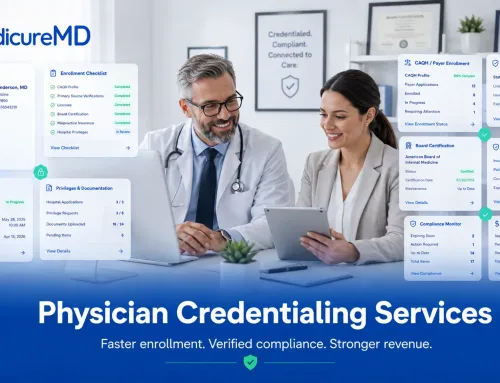
The single most critical administrative step for modern insurance panels is setting up and maintaining your profile with the Council for Affordable Quality Healthcare—recently rebranded as DataSpring.
Your portal profile operates as a centralized data room. Major commercial health insurance companies pull their primary source verification directly from this platform. If your profile is incomplete, un-attested, or contains expired liability dates, major behavioral networks like Optum, Magellan, or Humana Behavioral Health will automatically stall your application or issue immediate claim denials.
Keeping this profile continuously updated is a full-time compliance task, which is why utilizing specialized credentialing services can save your staff hours of manual data corrections.
The standard timeline for network approval spans roughly 90 to 120 days under National Committee for Quality Assurance (NCQA) guidelines. Understanding how that time is divided helps you set realistic expectations for your business revenue.
1.Profile Preparation and CAQH Setup:Weeks 1–2.
Gather all state licenses, NPI details, and proof of malpractice coverage. Input data into the provider portal and authorize target insurance networks to access your file.
2.Application Submission:Week 3.
Submit formal applications to chosen payer panels, ensuring state-specific network requirements are fully met.
3.Primary Source Verification (PSV):Weeks 4–8.
Payers directly verify your credentials with licensing boards and universities. Modern automated verification takes days, but manual outreach by slower payers can drag this step out for weeks.
4.Committee Review & Contract Issuance:Weeks 9–16.
The insurance company’s credentialing committee formally approves your network inclusion. They issue your commercial contract, establish your reimbursement rates, and load your NPI into their active claims processing directories.
Managing this entire process alone takes significant internal staff hours and administrative focus away from patient care. At MedicureMD, we offer full-service revenue cycle management and dedicated enrollment support built to streamline your practice growth.
Our expert team manages the tedious paperwork, tracks your application status daily, and handles re-credentialing alerts automatically so your practice never misses an insurance deadline.
Schedule an Appointment
How long does the mental health credentialing process take?
On average, the process takes between 90 to 120 days per insurance panel. The timeline depends heavily on how quickly the insurance committee meets and whether your profile data is completely error-free upon first submission.
Can I bill for my services while my credentialing application is still pending?
Generally, no. Most commercial payers do not allow retroactive billing before your official effective network date. If you see a patient while your application is pending, the claim will likely be rejected or processed as out-of-network, leaving the patient with unexpected costs.
What is the difference between individual and group credentialing?
Individual credentialing binds your specific license to a payer network, while group credentialing links multiple providers to a single Tax ID or organization. If you manage an expanding behavioral health group clinic, organizing your providers under a centralized group contract makes adding new staff members significantly faster.
How often do behavioral health providers need to go through re-credentialing?
Under current healthcare compliance regulations, most commercial health plans require formal re-credentialing every two to three years. Additionally, modern compliance standards increasingly mandate continuous monitoring—requiring monthly checks on active licenses, DEA status, and exclusion databases.