In the medical field, there are many terms thrown around that can confuse even the most seasoned doctors and patients alike. It’s important for anyone in healthcare to understand the jargon. Take pyrexia for example, it’s just a fancy word for fever.
Now, when it comes to credentialing, enrollment, and privileging, those can seem like real tongue-twisters. But we can break it down nice and easy. The differences between credentialing, enrollment, and privileging are complex ideas, but I’ll explain them simply.
|
C
|
redentialing is the process of verifying a healthcare provider’s qualifications like their license, education, and training. It’s how hospitals make sure the doctors on staff are properly certified to practice medicine. |
|
P
|
rivileging, on the other hand, authorizes specific healthcare providers to perform certain medical procedures based on their experience and expertise. For instance, a hospital may privilege only the most senior surgeons to conduct complex operations. |
|
E
|
nrollment refers to a healthcare provider joining a health insurance network so they can bill and get paid for treating patients with that insurance. Whether it’s with private insurance companies or government programs like Medicare and Medicaid, enrollment allows doctors to provide care to more people. |
Together, these three processes help ensure patients receive proper care from qualified and authorized healthcare providers while keeping your medical billing operations fluid.
What is Credentialing?
Basically, credentialing in healthcare is a process that guarantees patients are being treated by professionals who have the qualification, certification, required education, and experience necessary for providing care at a healthcare facility. This ensures patients receive the highest level of care from healthcare providers or practitioners.
Usually, the process of medical credentialing involves verification of the license, documentation, and clinical practice history of healthcare providers to ensure that they meet the set standards and regulations of delivering treatment at a particular healthcare facility. For practices operating across state lines, navigating regional differences—such as credentialing in Georgia vs. North Carolina—requires a strict review of state medical board mandates.
The 5-Step Credentialing Process
Before delivering treatment to any patient, healthcare providers undergo a complete process referred to as the credentialing process. It is vital for maintaining the quality and integrity of healthcare services.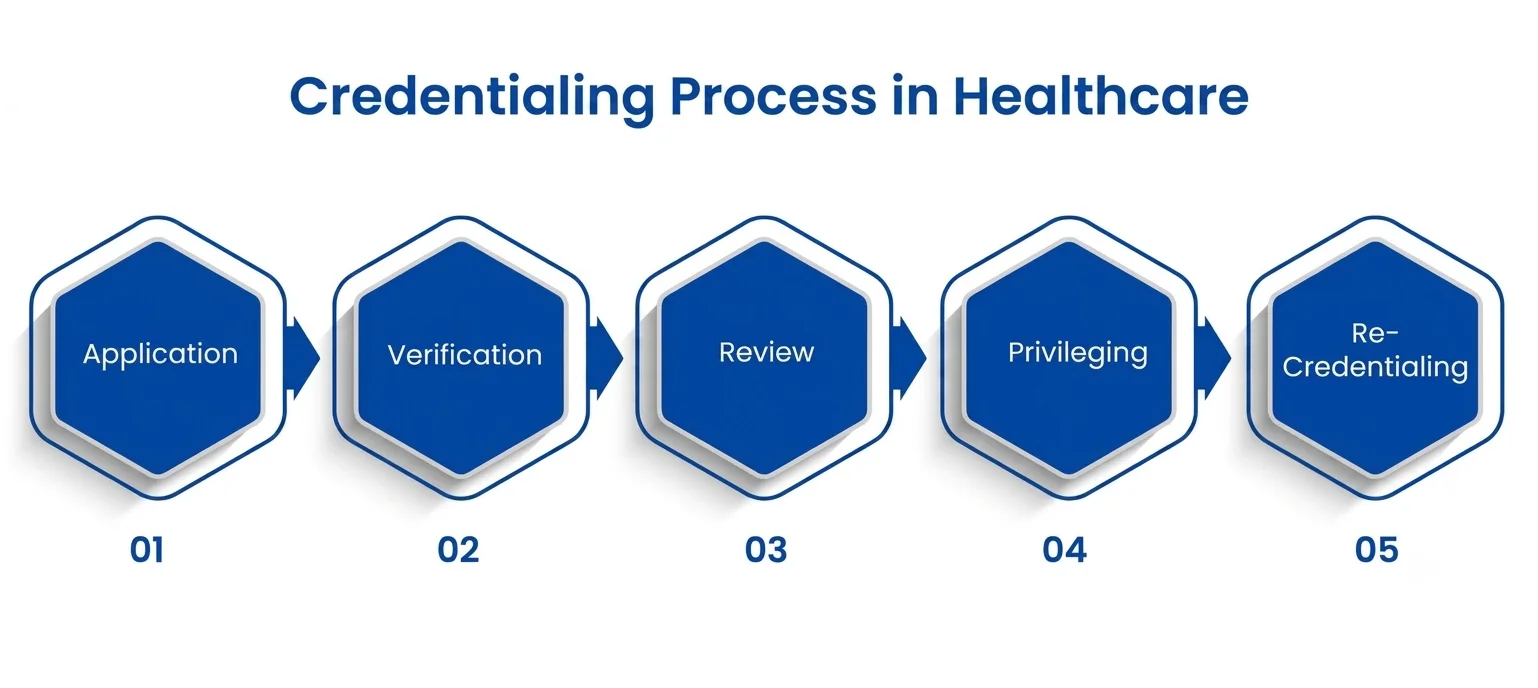
1.Application Submission:Step 1.
Providers apply to verifying organizations and data banks. Primary institutions include the National Practitioner Data Bank (NPDB), the American Board of Medical Specialties (ABMS), and the American Association of Nurse Practitioners (AANP). In addition, the Office of Inspector General (OIG) and System for Award Management (SAM) assist in verifying healthcare providers.
2.Primary Source Verification (PSV):Step 2.
The verifying organizations thoroughly inspect credentials by contacting the related background departments directly. This includes the provider’s educational institutions, licensing boards, and past clinic workstations to assess clinical practice history.
3.Committee Review:Step 3.
After verification, the concerned credentialing committee reviews the aggregated data received from the relevant departments and matches it with the data provided by the practitioners. They confirm if the provider meets the required standards of education, skills, training, and experience necessary for safe and effective treatment.
4.Credentailing Approval:Step 4.
This is the first true step towards practicing at a facility. The organization officially approves the provider’s application after the committee finishes its review, validating their foundational credentials.
5.Continuous Monitoring:Step 5.
The process of credentialing does not stop at approval. Organizations continuously monitor the provider’s credentials to remain in compliance with current year standards. If at any time a provider falls out of match with updated standards, facilities can restrict them from delivering treatment services until they apply for re-credentialing.
Who Verifies Credentials?
There are various primary agencies and organizations that verify credentials after checking raw data sources. Some of them include:
- National Practitioner Data Bank (NPDB)
- The American Board of Medical Specialties (ABMS)
- American Association of Nurse Practitioners (AANP)
- The Office of Inspector General (OIG)
- System for Award Management (SAM)
- State License Verification Boards
What is a Credentialing Checklist?
A credentialing checklist incorporates documents and data which are required for the credentialing process in healthcare. Before filing an application, new physicians must arrange these components:
- Personal information & Driver’s license
- Social Security card
- Medicaid & Medicare numbers
- Federal Tax ID number (TIN) or Employer Identification Number (EIN)
- Permanent Resident Card, Green Card, or visa status for non-US citizens
- Copy of all current active state license wallets
- Copy of current Federal DEA and State Controlled Substance Registrations
- Copy of medical school diploma, internship, residency, and fellowship certificates
- Copy of current Board Certificate (including issuing board name and dates)
- Work history including all practice locations and employment affiliations
- Professional and personal peer references
- Malpractice claims history with a 10-year insurance claims report
- Personal immunization records
- Active CAQH profile enrollment
- Clear OIG/SAM Exclusion Checks
Why is Credentialing Needed?
Credentialing plays a vital role in standardizing healthcare services. The main benefits include:
- Patient Safety: Only professional and qualified practitioners are allowed to provide care, which directly reduces medical errors.
- Credibility: Credentialing strengthens the reputation, authority, and trustworthiness of qualified healthcare providers.
- Compliance Assurance: Healthcare facilities successfully adhere to the regulatory requirements and standards set by state and federal organizations.
- Trust Building: Patients maintain significantly more trust and confidence in the skills and expertise of credentialed healthcare providers.
- Revenue Increase: Credentialed practitioners can receive more patients due to various health plan networks, which prevents revenue leakages and assists in steady growth.
What is Privileging in Healthcare?
Privileging in healthcare means allowing healthcare professionals to perform specific medical procedures or services within a particular facility. Their privileges are based on their verified credentials, localized competence, and specific experience.
In simple words, due to the privileging right, physicians provide their services at the most appropriate healthcare facility, which reduces the overall liability risk of healthcare organizations. Usually, privileging is the second step after the credentialing process. Upon completing credentialing, healthcare professionals are granted privileges.
What is Clinical or Hospital Privileging?
Clinical or hospital privileging is when a healthcare practitioner is allowed to perform a specific care procedure for a patient at a particular healthcare facility. There are three primary types of hospital privileges.
- Admitting Privileges: The rights of a physician granted by the hospital to admit patients for treatment to that particular hospital or healthcare facility.
- Courtesy Privileges: Authorizes physicians for occasional, sporadic treatment or admission to a hospital without full-time staff responsibilities.
- Surgical Privileges: Allows physicians to perform specific outpatient or operating room surgeries based on technical mastery.
The process of privileging involves defining needed privileges based on the provider’s experience, verifying credentials, conducting a localized peer review to evaluate clinical competence, and granting the final approval from the facility board.
What is Enrollment in Healthcare?
Enrollment is the process in which healthcare providers or practitioners apply for inclusion in an insurance provider’s network to receive reimbursement after providing care services to patients.
After credentialing, practitioners get privileges from providers to perform at a specific facility. After that, they are asked to apply for enrollment and come in-network with insurers. The process of enrollment is the final part of the chain (Credentialing $rightarrow$ Privileging $rightarrow$ Enrollment).
The 3-Step Enrollment Process
The process usually takes several weeks to several months to complete depending on how accurately providers submit their applications.
- Application: Providers submit an application for enrollment with insurers containing all necessary details like practice location, services offered, and their medical liability insurance coverage.
- Review: The insurance providers thoroughly review the application and supporting documents to decide whether they meet the required commercial standards for participation in their network.
- Approval & Contracting: If the insurance providers find that the providers are eligible, they accept their application, send a participation contract, and assign a provider ID network number.
Securing enrollment with major payers allows independent medical practices to remain financially viable. For instance, specialized practices handling complex diagnostic or clinical pathways must align their provider enrollment with exact specialties, such as structuring clean networks for family medicine billing to guarantee all routine care codes are covered.
Similarly, ensuring your practitioners are fully enrolled under specific healthcare pathways like internal medicine guarantees that complex chronic disease treatments are properly reimbursed. Without completing this phase, out-of-network claims lead to heavy denials, making dedicated general practice medical billing services highly crucial for sustaining consistent revenue.
| Feature | Credentialing | Privileging | Enrollment |
|---|---|---|---|
| Definition | Verifying healthcare providers’ qualifications and background. | Granting specific clinical practice rights within a facility. | Process for healthcare providers to join an insurance network. |
| Purpose | Ensure patient safety and quality care. | Define scope of practice within a facility. | Enable providers to receive payment for services from insurance. |
| Process | Application, verification, review, approval, monitoring. | Application, verification, peer review, approval, monitoring. | Application, review, approval. |
| Outcome | Qualified providers can practice at a facility. | Providers can perform specific procedures at a facility. | Providers can bill insurance for services rendered to patients. |
| Key Players | Healthcare facilities, credentialing bodies, providers. | Healthcare facilities, providers. | Healthcare providers, insurance companies. |
| Timeline | Ongoing process with periodic re-credentialing. | Ongoing process with periodic re-privileging. | Ongoing process with potential changes during open enrollment. |
| Credentialing focuses on verifying a provider’s qualifications to practice. Privileging focuses on defining what a provider can do at a specific facility. Enrollment focuses on enabling providers to get paid by insurance companies. | |||
FAQ’s
What are the four levels of credentialing procedures?
The four levels of credentialing procedures, often seen within specialized advocacy and counseling tracks (like the National Advocacy Credentialing Program), include:
- Provisional: No extensive experience required, but requires a 40-hour pre-approved training program.
- Basic: Minimum of 3,900 hours of documented specialty experience.
- Intermediate: Minimum of 7,800 hours of documented specialty experience.
- Advanced: Minimum of 15,600 hours of documented specialty experience.
What are the mechanisms of credentialing?
Mechanisms represent the foundational components of how credentialing works: submitting the primary application, primary source verification (PSV), collecting peer references, committee review, final decision, facility privileging coordination, ongoing monitoring, and cyclical re-credentialing.
What are three privileges that healthcare professionals have?
The three primary clinical privileges granted within hospitals are admitting privileges, courtesy privileges, and specialized surgical privileges.
What is open enrollment?
Open enrollment is a specific time period (usually occurring in the fall) in which insurance plan participants or employees are allowed to log in, select, adjust, or cancel their health insurance benefit plans. It happens once a year for a limited window of a few weeks.
What is a payer enrollment?
Payer enrollment is the exact same process as provider enrollment. It is the administrative process of a healthcare provider applying to join an insurance company’s provider panel or public health program network to become an authorized “in-network” provider.