Difference Between Credentialing in Georgia vs North Carolina
What Is Medical Credentialing and Why Does It Differ by State?
Medical credentialing is the process by which healthcare providers verify their qualifications — education, training, licensure, and experience — with payers, hospitals, and state medical boards. It is a requirement for billing insurance, joining a hospital medical staff, and practicing legally in any U.S. state.
Each state has its own medical board, nursing board, and regulatory bodies that oversee provider credentialing, and how those bodies handle applications, documentation, processing timelines, and renewal obligations can vary significantly from one state to the next. Georgia and North Carolina are a perfect example of this.
Credentialing in Georgia — Key Facts
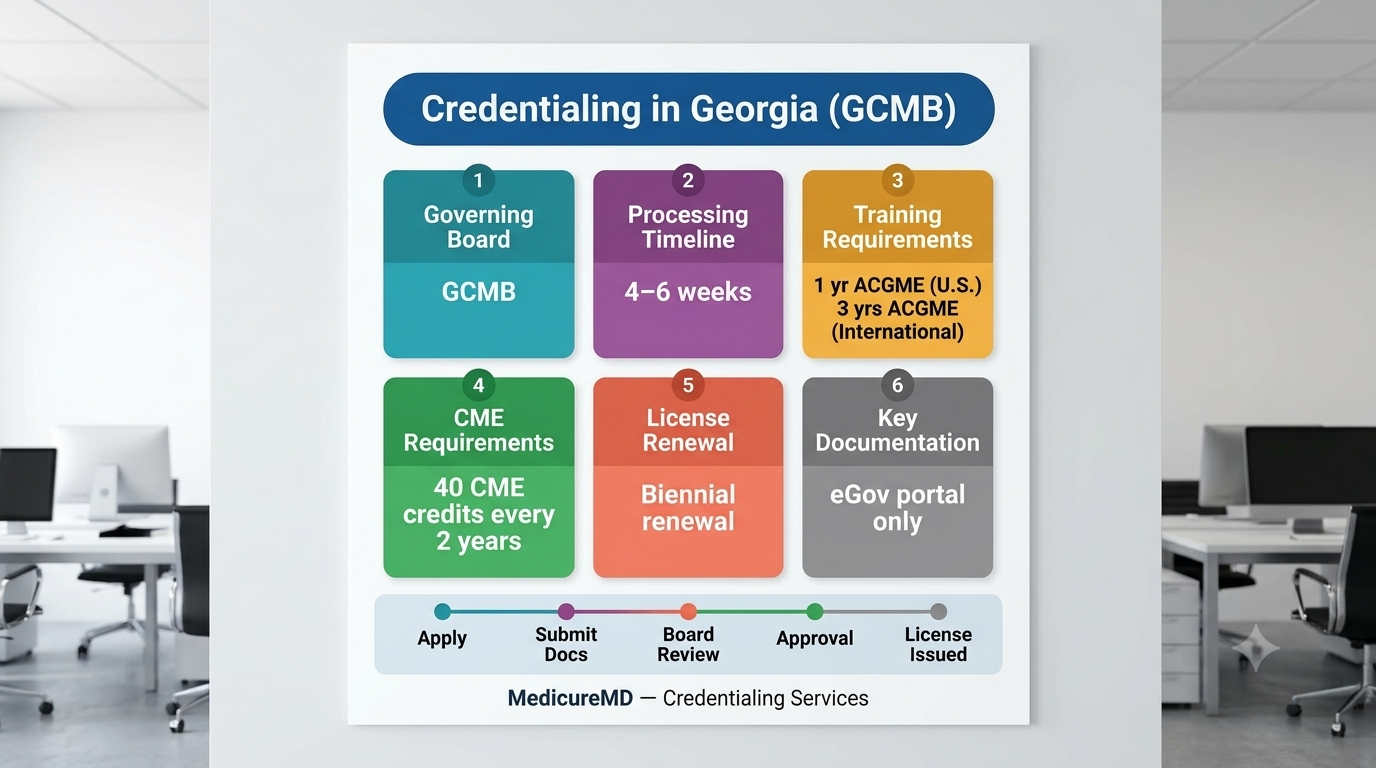
Credentialing in Georgia vs North Carolina starts with understanding who governs the process. In Georgia, medical credentialing falls under the Georgia Composite Medical Board (GCMB), which oversees physician licensure, credential verification, and ongoing compliance for all healthcare providers practicing in the state.
Georgia Processing Timeline
Absent any complicating factors, the average Georgia medical license application takes approximately four to six weeks to complete. Once the application is complete, the board notifies the applicant in writing of the initial determination and the next scheduled board meeting date at which the application will be reviewed.
Georgia Training Requirements
For U.S. board-approved medical school graduates, at least one year of ACGME-accredited training is required. For international or non-approved medical school graduates, at least three years of ACGME-accredited training is required.
Georgia CME Requirements
The Georgia Composite Medical Board requires 40 MD/DO CME credits and 40 AMA PRA Category 1 Credits every two years. This is a shorter cycle and lower credit threshold compared to North Carolina, which matters for multi-state providers managing CME across both states simultaneously.
Georgia License Renewal
The Georgia medical license renews biennially by the last day of the provider’s birth month. Providers cannot practice medicine after the expiration date of the license. Georgia also now operates as a fully electronic system — all documents must be uploaded through the eGov portal; physical forms and checks are no longer accepted.
Georgia Key Documentation
The GCMB requires primary source verification for all credentials. Applicants must request that third parties — including medical schools, residency programs, and reference authors — submit documents directly to the Board via the NextRequest portal. Applicants cannot submit these documents themselves. This includes FCVS profiles, medical school transcripts, USMLE/COMLEX scores, and postgraduate training certificates.
Credentialing in North Carolina — Key Facts
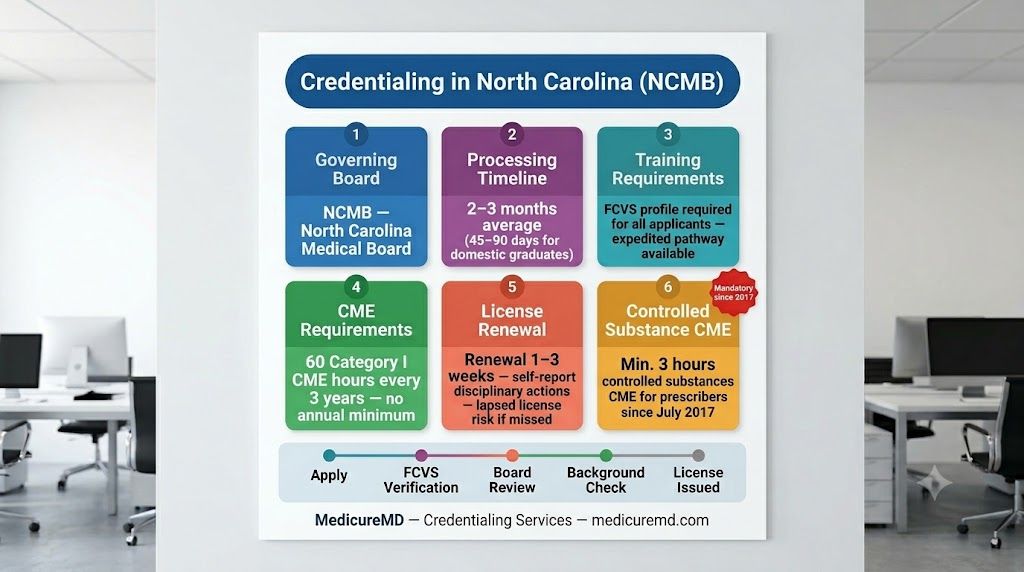
North Carolina medical credentialing is governed by the North Carolina Medical Board (NCMB), one of the more structured and documentation-heavy boards in the Southeast. Providers applying for credentialing in North Carolina vs Georgia will immediately notice that the process is longer and the CME requirements are more demanding.
North Carolina Processing Timeline
The average processing time for a North Carolina medical license is approximately two to three months, given there are no disciplinary actions, malpractice claims, or criminal records on the background check. Foreign medical graduates may see an even longer processing period due to international credential verification. MedLicense.com reports averaging 45 to 90 days for domestic graduates from the submission of the application to the NC Medical Board to the issuance of the license.
North Carolina Training Requirements
North Carolina requires an FCVS (Federation Credentials Verification Service) profile for all applicants, which centralizes primary source verification and can speed up the process — especially for providers applying to multiple states. An expedited pathway is also available for eligible physicians.
Physicians may be eligible for expedited North Carolina medical license application if they have completed specialty board certification within the last 10 years, hold a full unrestricted active license in one state for the previous five years, and have been actively practicing clinical care for an average of 20 or more hours per week for at least the last two years.
North Carolina CME Requirements
This is one of the most significant differences in credentialing in Georgia vs North Carolina. The CME requirement for physicians in North Carolina is at least 60 hours of Category I CME completed over a three-year cycle. There is no minimum CME that needs to be taken per year.
Physicians who prescribe controlled substances must complete at least three hours of controlled substances CME from the required 60 Category I CME credits. This rule has been in place since July 2017 and applies to all active license holders in the state.
North Carolina License Renewal
Renewal processing time in North Carolina is typically one to three weeks. Providers must self-report any disciplinary actions, malpractice settlements, or criminal convictions during the renewal process. Missing a renewal deadline can result in a lapsed license and financial penalties.
Credentialing in Georgia vs North Carolina — Side-by-Side Comparison
| Factor | Georgia (GCMB) | North Carolina (NCMB) |
|---|---|---|
| Governing Board | Georgia Composite Medical Board | North Carolina Medical Board |
| Processing Time | 4 to 6 weeks (average) | 2 to 3 months (average) |
| CME Credits Required | 40 AMA PRA Category 1 every 2 years | 60 Category I CME every 3 years |
| Controlled Substance CME | Not specifically mandated | Minimum 3 hours required |
| FCVS Profile Required | Optional (can be used) | Required for all applicants |
| License Renewal Cycle | Every 2 years (birth month) | Every 1 year (birthday) |
| ACGME Training (Domestic) | Minimum 1 year required | Required per board standards |
| Document Submission | Fully electronic via eGov portal | FCVS + NCMB online application |
| Expedited Pathway | Temporary license available | Available for board-certified MDs |
| Background Check | Not currently required by GCMB | Required; discrepancies cause delays |
Common Credentialing Mistakes That Delay Approval in Both States
Whether you are working on credentialing in Georgia vs North Carolina — or both at the same time — the same types of errors tend to cause the most delays:
- Incomplete primary source verification: Both boards require documents sent directly from third parties. An applicant-submitted document will be rejected outright.
- Missing CME documentation: Providers often underestimate how strict both boards are about CME compliance during renewal. North Carolina in particular tracks CME cycle-by-cycle with no carryover.
- Undisclosed malpractice or disciplinary history: North Carolina’s background check process means any discrepancy between what is reported and what is discovered will result in a board review and significant delays.
- Letting applications go stale: Georgia requires applications to be completed within 360 days of starting, or they are closed entirely.
- Forgetting PDMP registration: Georgia requires providers who hold a DEA registration to register with the Georgia PDMP within 30 days of initial licensure.
How MedicureMD Handles Credentialing Across 13 States
Credentialing in one state is already time-consuming. Managing it across Georgia, North Carolina, Virginia, South Carolina, Florida, Alabama, Texas, Tennessee, West Virginia, Pennsylvania, New York, New Jersey, and Maryland simultaneously is a full-time job on its own.
MedicureMD’s credentialing services take that workload off your plate completely. Our credentialing specialists are trained on the specific requirements of each state we serve — including the GCMB’s eGov portal documentation rules and NCMB’s FCVS and background check requirements. We track your renewal dates, CME cycles, and payer enrollment deadlines so nothing slips through the cracks while you focus on patient care.
Whether you are a solo provider just entering Georgia or a multi-specialty group expanding across the Southeast and Mid-Atlantic, our team manages every step — from initial application and primary source verification to ongoing renewals and payer credentialing updates.
Do Not Let Credentialing Delays Cost You Revenue
Every day a provider is not credentialed is a day of unbillable patient care. Let MedicureMD manage your credentialing in Georgia, North Carolina, and across all 13 states we serve — fast, accurate, and fully compliant.
FAQ’s
How long does credentialing take in Georgia vs North Carolina?
Georgia credentialing typically takes four to six weeks through the GCMB. North Carolina credentialing takes two to three months on average through the NCMB. Foreign medical graduates and providers with malpractice or disciplinary history may experience longer timelines in both states.
What are the CME requirements for credentialing in Georgia vs North Carolina?
Georgia requires 40 AMA PRA Category 1 CME credits every two years. North Carolina requires 60 Category I CME credits every three years, with at least three of those hours focused on controlled substance prescribing for providers who prescribe controlled substances.
Is the FCVS profile required in both states?
North Carolina requires an FCVS profile for all applicants. In Georgia, an FCVS profile is optional but can be used to streamline the verification process, particularly for providers applying in multiple states.
Can a provider practice while their application is being processed in Georgia?
No. The Georgia Composite Medical Board advises applicants not to accept employment until they have received their Georgia Medical License or Certificate. Practicing without an active license is not permitted.
Does MedicureMD handle credentialing in both Georgia and North Carolina?
Yes. MedicureMD provides full credentialing services in Georgia, North Carolina, and 11 additional states — Virginia, South Carolina, Florida, Alabama, Texas, Tennessee, West Virginia, Pennsylvania, New York, New Jersey, and Maryland. Our team manages everything from initial applications to ongoing renewal tracking.