

Healthcare is a complex industry with lots of moving parts, and timely filing the medical claims helps ensure a smooth reimbursement flow. If you miss a deadline, everything can stop working.
As a healthcare worker, you work really hard to help patients get the care they need. So getting paid for that care should be easy. But when claims aren’t filed on time, that’s exactly what happens. Denials pile up, revenue drops, and you’re left with a mountain of paperwork and rejection letters.
The good news? Timely Filing claims on time doesn’t have to be a struggle! Insurance companies give you anywhere from 30 to 180 days to submit claims after the date of service. Some let you have up to a year or even longer. That’s plenty of wiggle room.
This article will be your timely filing roadmap. Let’s go over the basic filing limits for major insurance plans. You’ll find out how to avoid mistakes that slow down your claims. We’ll give you great tips to help you meet all your deadlines, every single time! Stay with us, and you won’t miss any more cutoffs! Your reimbursements will go through easily. Your days of denial and deferred revenue will be over. Imagine this you can use that saved time and money for what really counts: your patients.
What is Timely Filing in Healthcare?
Timely filing refers to the specific timeframe within which healthcare providers must submit claims to insurance companies for the services they’ve provided. It’s essentially a deadline for filing claims. If providers fail to submit their claims within this predefined timely filing limit, the insurance companies will deny the claims, and the providers won’t get paid for the care they’ve given to patients covered by that insurance plan.
Additionally, the timely filing term also applies to the timeframe providers have to submit appeals for any denied claims. Some insurance companies set the same timely filing limits for both initial claims and appeals for denied claims.
✨ For example:
Let’s say a doctor sees a patient with Aetna on January 1st. Knowing the exact timely filing rules is crucial here because missing the window means lost revenue.
If the plan has a specific 120-day limit, the office needs to file the claim by early May.
If they miss that window and submit late, the insurer can deny the claim completely, and the provider cannot bill the patient for the balance.
Let’s say a doctor sees a patient with Aetna on January 1st. Knowing the exact timely filing for aetna rules is crucial here because missing the window means lost revenue. If the plan has a specific 120-day limit, the office needs to file the claim by early May. If they miss that window and submit late, the insurer can deny the claim completely, and the provider cannot bill the patient for the balance.
Similarly, if the insurer initially denies the claim (even if it was filed on time), the doctor’s office must quickly review the payer documentation to submit an appeal contesting the denial before the secondary deadline runs out. Learning how to read an aetna insurance card upfront can prevent these errors by helping your billing team identify the correct payer ID and submission pathway right away.
| # | Insurance Company | Filing Limit |
|---|---|---|
| 1 | Aetna | 120 Days |
| 2 | Aetna Better Health | 180 Days |
| 3 | Aetna Better Health Kids | 180 Days |
| 4 | Ambetter | 180 Days |
| 5 | AvMed | 1 Year |
| 6 | Beacon Health | 90 Days |
| 7 | Buckeye | 1 Year |
| 8 | Caresource | 90 Days |
| 9 | Cenpatico | 90 Days |
| 10 | Champus | 1 Year |
| 11 | Cigna | 90 Days |
| 12 | Cigna (Out of Network) | 180 Days |
| 13 | Emblem Health | 120 Days |
| 14 | Fidelis New York | 90 Days |
| 15 | GEHA | 90 Days |
| 16 | Harvard Pilgrim Health Care | 90 Days |
| 17 | Humana | 90 Days |
| 18 | Kaiser Permanente | 180 Days |
| 19 | Magellan | 60 Days |
| 20 | McLaren Health Plan | 1 Year |
| 21 | Medical Mutual | 1 Year |
| 22 | Medicare | 1 Year |
| 23 | Medicaid | 180 Days |
| 24 | Meridian | 1 Year |
| 25 | United Healthcare | 90 Days |
Initial claims only | Always verify directly with the payer for updates
How to Easily Find Timely Filing Limits?
Don’t stress about locating timely filing limits for insurance claims. We’ve got you covered with a valuable guide that clearly outlines the timely filing limits for various insurance providers. Save time and effort by referring to our comprehensive resource.
- Medicare: 1 year
- Medicaid: Varies by state, often 90 days to 1 year
- Commercial Insurers: 90–180 days, but can be longer
Timely Filing Limits of Different Insurance Companies
The table below shows the timely filing limits for different healthcare insurance companies in the USA.
Keep in mind that these time frames can vary based on the state where the insurer operates and the specific plan type. Many payers offer consistent time limits for denied claims, but we recommend checking their official portals for specific plan guidelines.
Timely Filing Limit for BCBS (Blue Cross Blue Shield) by State
| # | Insurance Company / State / Plan | Filing Limit (From Date of Service) |
|---|---|---|
| 1 | BCBS Alabama | 2 Years |
| 2 | BCBS Alaska / Arizona / Mississippi | 1 Year |
| 3 | BCBS Arkansas / Idaho / Illinois / New Mexico / Oklahoma | 180 Days |
| 4 | BCBS Florida (Florida Blue) | 1 Year |
| 5 | BCBS Georgia | 180 Days |
| 6 | BCBS Kansas | 12 Months |
| 7 | BCBS Louisiana | 15 Months |
| 8 | BCBS Massachusetts (HMO, PPO Medicare Advantage) | 90 Days |
| 9 | BCBS Massachusetts (Indemnity) | 1 Year |
| 10 | BCBS Michigan | 180 Days (1 Year for BCBS Complete Plans) |
| 11 | BCBS Minnesota / Montana / North Dakota | 180 Days |
| 12 | BCBS North Carolina | 18 Months |
| 13 | BCBS New York (Empire BCBS) | 1 Year |
| 14 | BCBS Rhode Island | 180 Days |
| 15 | BCBS Tennessee | 120 Days |
| 16 | BCBS Texas | 95 Days |
| 17 | BCBS Vermont | 180 Days |
| 18 | BCBS Wyoming | 60 Days |
| 19 | Anthem BCBS (Ohio, Kentucky, Indiana, Wisconsin, California) | 90 Days |
| 20 | Carefirst Washington DC | 1 Year |
| 21 | Highmark BCBS Delaware | 120 Days |
| 22 | Horizon BCBS New Jersey | 180 Days |
| 23 | Independence Blue Cross | 120 Days |
| 24 | Wellmark BCBS Iowa and South Dakota | 180 Days |
| 25 | BCBS Nebraska | Check with each individual plan as they vary widely |
Initial claims only | Always verify directly with the payer for updates
✨ Tips to Beat the Clock
- File ASAP: Don’t delay until the deadline nears. Filing daily or weekly gives your revenue cycle team enough cushion to fix clearinghouse rejections before the hard payer deadline hits.
- Confirm Eligibility Upfront: Verify real-time eligibility (RTE) before services are rendered. This prevents the claim from bouncing due to terminated coverage, which eats up precious filing time.
- Watch for Payer Requests: Respond to coordination of benefits (COB) or medical record requests immediately to keep the claim moving forward.
- Track the Clearinghouse Reports: A claim accepted by your software isn’t officially filed until it passes clearinghouse validation and is accepted by the payer. Monitor 277 electronic claim status responses regularly.
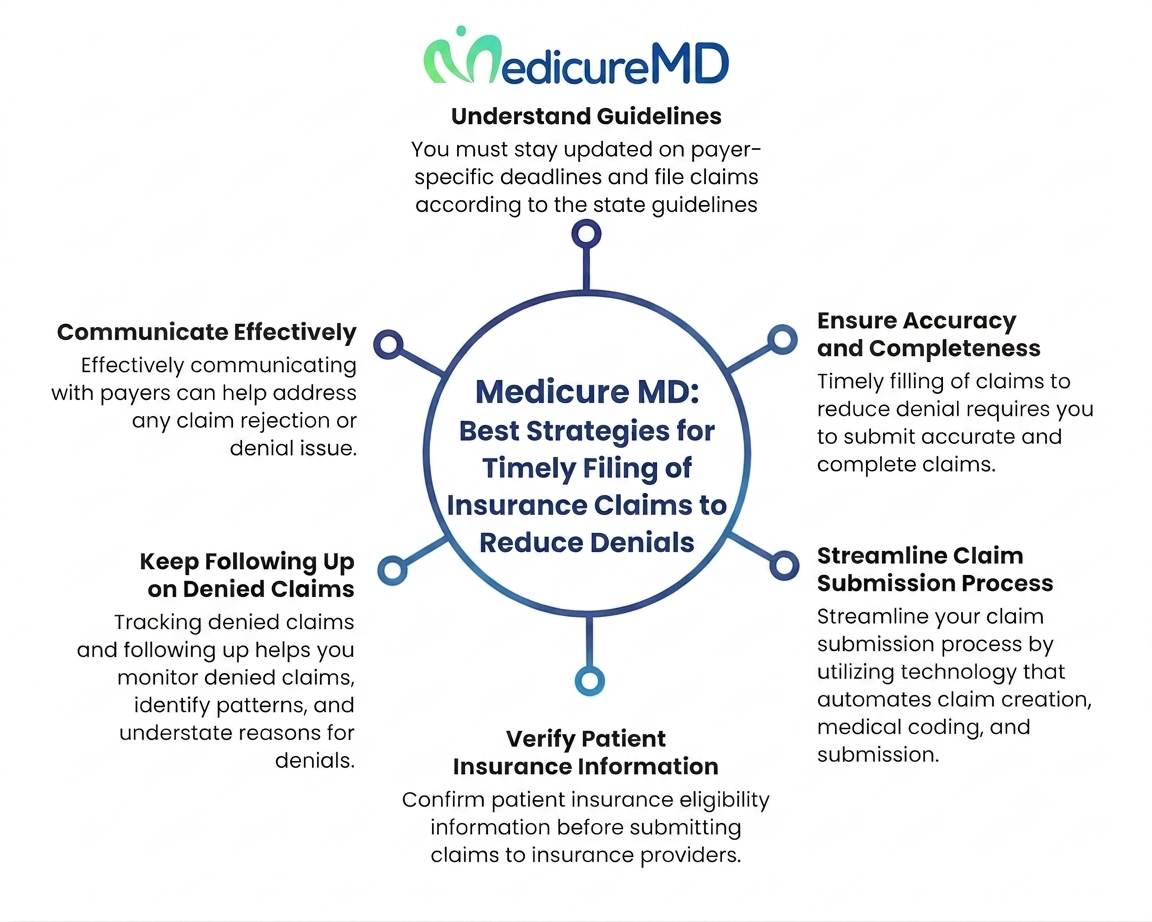
Best Strategies for Timely Filing of insurance claims to reduce denials
The Importance of Timely Filing Limits for Healthcare Providers
It’s really important for healthcare providers in the United States to submit insurance claims on time. Filing on time might feel monotonous, but it can really help improve your medical practice’s bottom line. Here’s why it matters:
-
Speedy Reimbursement: The sooner you submit a claim, the sooner you’ll receive reimbursement. This improves cash flow, allowing you to cover overhead and pay employees and vendors on schedule.
-
Higher Acceptance Rates: Insurance companies are much more likely to pay claims if you submit them on time. After the deadline passes, they will outright deny the claim, and you are legally barred from billing the patient for contractual provider write-offs.
-
Fewer Hassles: Submitting late leads to timely filing appeals, which require tracking down proof of timely submission (like certified mail receipts or clearinghouse acceptance logs).
-
Compliance & Contracting: Insurance contracts require filing within a certain window. Consistently missing these timelines can trigger payer audits or jeopardize your in-network credentialing status.
Smart Ways to File Insurance Claims on Time and Avoid Denials
When insurance claims get denied, it can really stress out healthcare workers. It makes them frustrated, slows down payments, and can even cost money. If you use some smart tips, you can make filing claims easier, send them in on time, and reduce the chances of getting denied.
Get to Know Payer Guidelines Really Well
First, you need to know the rules and deadlines for each payer really well. These can be completely different depending on where you live and which insurance company you choose. Keep a centralized grid of these rules updated inside your billing software.
Automate and Streamline the Submission Process
Filing claims manually can lead to mistakes and take longer than it should. Automate your workflows using electronic data interchange (EDI) transactions to batch-submit claims directly to the clearinghouse daily.
Prioritize Accuracy and Completeness
A small mistake or missing detail can mess up a claim. Ensure your clinical documentation perfectly backs up your medical coding. Specialized specialties require targeted billing workflows to keep clean claim rates high; for instance, managing complex modalities requires expert family medicine billing strategies, while detailed diagnostic cognitive care demands highly accurate internal medicine workflows to pass strict payer scrubbing rules.
Verify Patient Details Upfront
Wrong or outdated patient insurance information is a big reason why claims get denied. Confirm the patient’s plan enrollment, coverage details, and filing requirements before rendering services. Update records proactively to reflect any changes. For community practices, utilizing dedicated general practice medical billing services can safeguard your front desk workflows against these avoidable eligibility slip-ups.
Stop Chasing Rejections: Partner with MedicureMD
Are you having a hard time with claims getting denied and waiting a long time for your money back? Outsource your medical billing and claim filing to MedicureMD and get paid faster. Our skilled billing team makes sure your claims are scrubbed, submitted electronically, and tracked down within their exact timely filing windows.
Plus, MedicureMD provides full revenue cycle management (RCM), compliant medical coding, denial management, and accounts receivable tracking to optimize your collection rate. Join forces with MedicureMD today and stop wasting time waiting for payments.