
How to Get Credentialed With Insurance Companies: A Step-by-Step Guide for Providers
By MedicureMD Billing Team. Reviewed by an AAPC-certified coder.
If you want to accept insurance, you have to be credentialed first. Whether you are opening a new practice, joining a group or adding a new payer, the process takes time, and mistakes can delay it by months. This guide explains how to get credentialed with insurance companies in 8 simple steps, what to prepare, how long it takes and where providers usually get stuck.
What Does It Mean to Get Credentialed With Insurance?
Getting credentialed means an insurance company checks your qualifications (license, education, training, work history and malpractice record) and approves you to join its network. After that, you are enrolled in the plans you applied for and can bill that payer. Until then, claims for that payer are often denied or paid as out-of-network.
This is different from the review inside a hospital, and it is not a one-time task. For a deeper look at each stage, read our guide to the medical credentialing process.
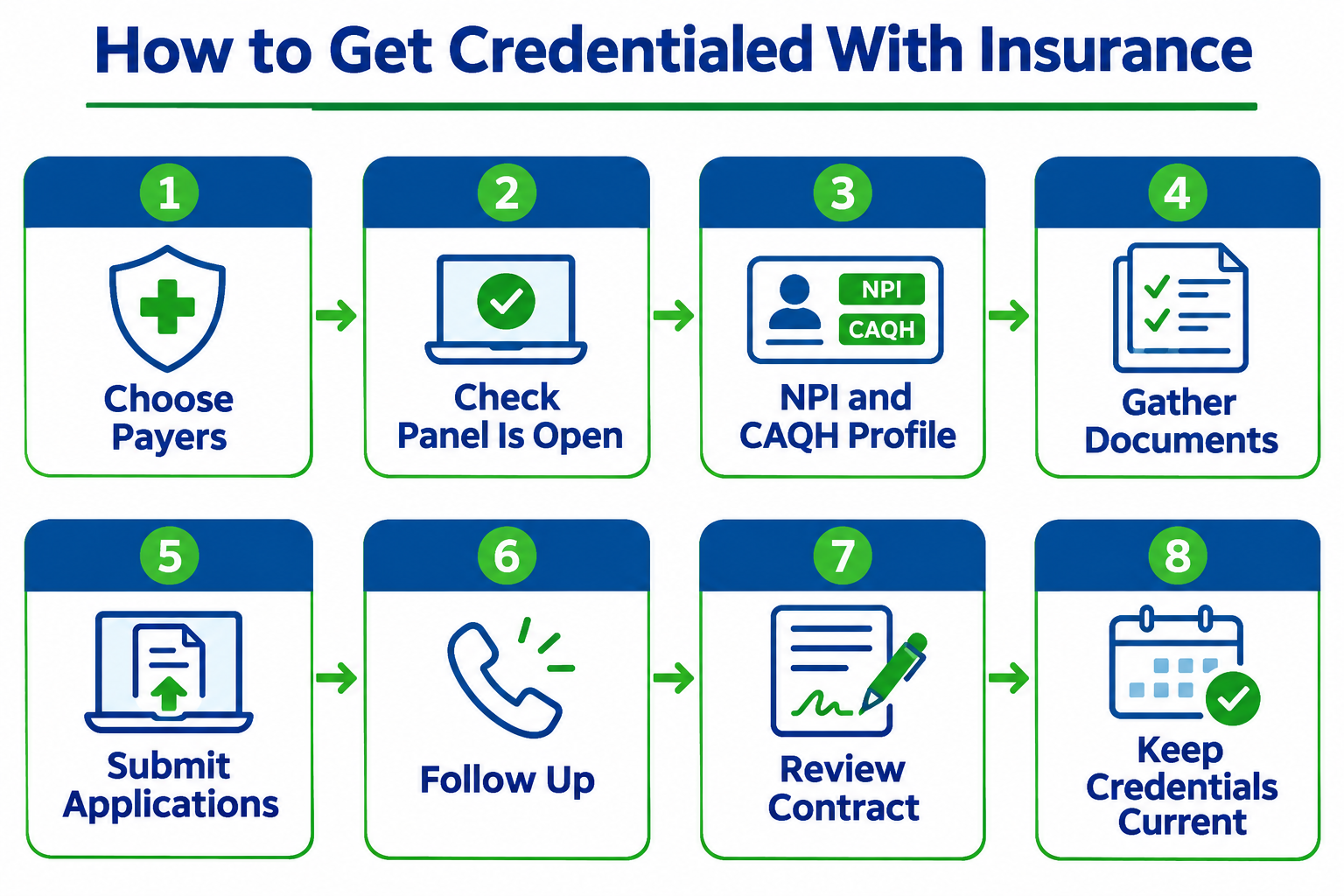
How to Get Credentialed With Insurance Companies: 8 Steps
1. Decide which insurance companies to join
Look at which payers your patients use in your area. Most practices start with Medicare, Medicaid and the largest commercial plans, then add more over time.
2. Check whether the panel is open
Some insurance companies close their panels in areas where they already have enough providers. Ask each payer before you spend time on an application.
3. Get your NPI and set up your CAQH profile
Every provider needs a National Provider Identifier from NPPES. Most commercial payers also pull your details from a CAQH profile, so it must be complete and attested.
4. Gather your documents
You will need your license, DEA registration if you prescribe, board certification, education and training details, work history without unexplained gaps, malpractice insurance and a current CV.
5. Submit your applications
Apply to each payer separately. Medicare enrollment goes through PECOS, and Medicaid has its own state application.
6. Respond quickly and follow up
Payers verify your information with the licensing board, schools and past employers. They may ask for more documents. Answer fast and check the status of each application regularly.
7. Review the contract and the effective date
After approval you will get a contract with your rates and a participation effective date. Check the date carefully, because visits before it may not be paid.
8. Keep your credentials current
Update your CAQH profile on schedule and renew your license, DEA and malpractice coverage on time. Payers also require recredentialing, usually about every three years.
How Long Does It Take to Get Credentialed With Insurance?
When you learn how to get credentialed with insurance, the timeline is often the biggest surprise. In our experience, a typical credentialing project takes 60 to 120 days, depending on the payer, the state and how complete your application is. Incomplete CAQH profiles, expired documents and slow responses are the most common reasons for delay, so start at least 3 to 4 months before you want to see insured patients.
Common Mistakes When Getting Credentialed With Insurance
- Starting too late and seeing patients before the effective date
- Leaving your CAQH profile incomplete or not re-attested
- Submitting expired licenses or malpractice certificates
- Gaps in work history with no explanation
- Applying to a closed panel without checking first
- Not following up after applying
Anyone who wants to know how to get credentialed with insurance without delays should avoid these mistakes. They often show up later as denied claims, even when the coding is perfect. If your claims are being denied and you are not sure why, a free billing audit can show whether credentialing is part of the problem.
Do It Yourself or Get Help?
Knowing how to get credentialed with insurance is one thing, and doing it across several payers is another. You can handle credentialing on your own, but it takes a lot of time to track applications across several payers. Many practices hand it to a team that prepares the applications, keeps CAQH up to date and follows up with every payer. At MedicureMD, our credentialing services include payer enrollment, CAQH management and weekly status updates. If you are a behavioral health provider, see our page on mental health credentialing services.
MedicureMD is a U.S.-based team of AAPC-certified coders and billers serving 500+ physicians across 30+ specialties. Pricing is a custom quote, with no long-term contract, only 30 days notice.
Frequently Asked Questions About Getting Credentialed With Insurance
How do I get credentialed with insurance companies?
Decide which payers to join, check that their panels are open, set up your NPI and CAQH profile, gather your documents, apply to each payer, respond to verification requests and sign the contract once approved.
How long does it take to get credentialed with insurance?
A typical project takes 60 to 120 days, depending on the payer, the state and how complete your application is.
Can I see patients before I am credentialed?
In most cases claims for visits before your effective date will be denied or paid as out-of-network, so it is best to wait for approval or confirm the payer’s rules in writing.
Do therapists and mental health providers need credentialing?
Yes. If you want to accept insurance, you need to be credentialed with each payer, and behavioral health applications are often reviewed closely for scope of practice and supervision.
Can a credentialing company do this for me?
Yes. A credentialing team prepares your applications, keeps your CAQH profile current and follows up with each payer until you are approved.