

If you work in medical billing anywhere in the United States, you have almost certainly come across the CO-45 denial code on an Explanation of Benefits or an Electronic Remittance Advice. It is one of the most frequently appearing adjustment codes in the entire billing process, and yet it is also one of the most misunderstood. Some billing teams treat it as a routine write-off and move on. Others panic, resubmit claims unnecessarily, or worse, try to pass the balance to the patient, which is a direct compliance violation.
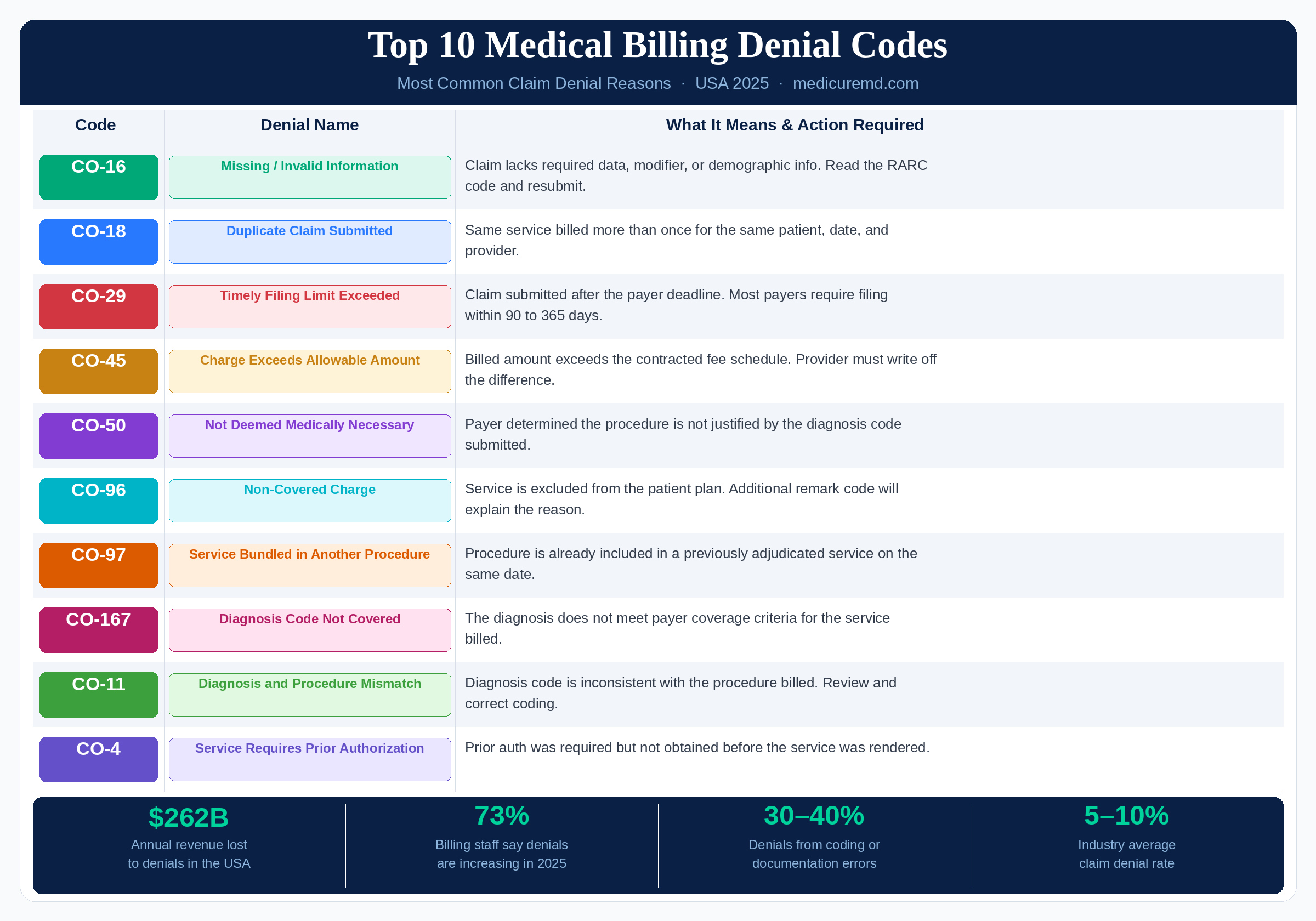
Understanding the CO-45 denial code correctly, what it means, why it appears, when to accept it, and when to fight it, is a skill that every biller, coder, and practice manager in the USA needs to have locked in. This guide covers all of it.
What Is the CO-45 Denial Code
The CO-45 denial code indicates a Contractual Obligation adjustment. It means the payer has reduced the billed amount because the provider agreed to accept a lower, contractually negotiated rate.
Breaking that down a bit more, when your practice joins an insurance network, whether that is Medicare, Medicaid, Blue Cross Blue Shield, Aetna, Cigna, or any other payer, you sign a contract that sets the maximum amount you can collect for each procedure or service. That contracted rate is called the allowable amount. When your billed charge is higher than that allowable amount, the payer reduces the payment to match the contract, and the difference gets flagged with the CO-45 denial code on the remittance.
When CO-45 is applied, the adjusted portion must be written off by the provider. It is not recoverable from the patient and does not require claim resubmission in most cases. This adjustment ensures compliance with payer contracts and standardized reimbursement rules.
Here is a simple example to make it concrete. Your practice bills $250 for an office visit. The contracted allowable amount with the payer is $180. The payer pays $150 (after the patient’s $30 copay is factored in) and posts a CO-45 denial code adjustment of $70. That $70 is the difference between what you billed and what the contract allows. It gets written off. The patient does not owe it. You cannot collect it.
The CO-45 amount represents the contractual adjustment and must be written off. Attempting to collect this from the patient violates payer agreements and could lead to compliance issues.
CO-45 Is Not Always a True Denial
This is the part that confuses a lot of people. The CO-45 denial code is technically a claim adjustment reason code, not a denial in the traditional sense. A true denial means the claim was rejected and no payment was issued. CO-45 typically appears alongside a payment, not instead of one.
CO-45 enforces payer-provider contract terms by reducing charges that exceed the negotiated fee schedule. Understanding what CO-45 means and how it impacts insurance reimbursement helps providers avoid compliance issues, unnecessary appeals, and revenue leakage.
When your billing team understands this distinction, it changes how they approach payment posting. A CO-45 denial code adjustment does not need to be resubmitted. It needs to be reviewed, verified against your contract, and posted correctly as a write-off if the adjustment is valid.
For practices looking to build tighter controls around how contractual adjustments are handled across the revenue cycle, MedicureMD offers dedicated billing support and denial management tools tailored to USA healthcare providers.
CO-45 vs PR-45: A Critical Difference
|
Feature |
CO-45 |
PR-45 |
| Full Name | Contractual Obligation | Patient Responsibility |
| Who Absorbs the Cost | Provider | Patient |
| Can You Bill the Patient | No | Yes |
| Requires Claim Resubmission | No | No |
| Must Be Written Off | Yes | No |
| Appears On | EOB / ERA | EOB / ERA |
| Appeal Possible | Yes, if adjustment is incorrect | Rarely |
| Common Trigger | Billed amount exceeds contracted rate | Patient deductible or coinsurance not met |
| Compliance Risk if Mishandled | Balance billing violation | Incorrect patient statement |
| Action Required | Verify against contract, then write off |
Bill patient for correct amount |
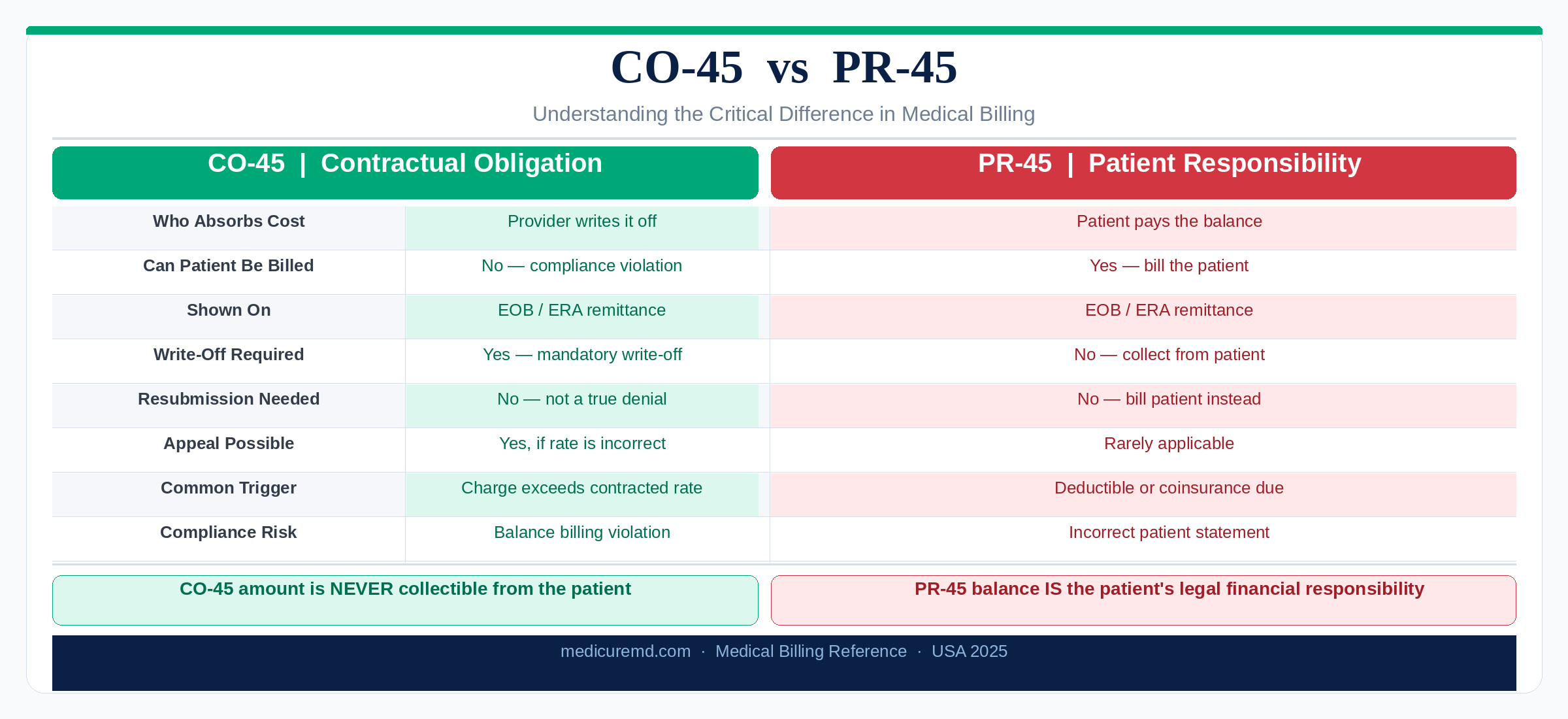
One of the most consequential mistakes a billing team can make is confusing the CO-45 denial code with PR-45. Both carry the same reason code number, 45, but the prefix changes everything.
CO-45 is a contractual obligation write-off where the provider absorbs the cost. PR-45 is patient responsibility where the patient owes the balance. Same reason code number 45, but the group code prefix completely changes who pays.
CO stands for Contractual Obligation. When you see CO in front of a code, the provider absorbs that adjustment. It goes into the write-off bucket. You cannot bill the patient for it.
PR stands for Patient Responsibility. When you see PR in front of the code, the patient legitimately owes that balance. It should appear on the patient’s statement.
Mixing these up during payment posting creates compliance problems and incorrect patient statements. CO means write it off. PR means bill the patient.
Training every member of your billing and front-desk team to recognize this difference is not optional. In states like Texas, California, New York, and Florida where patient billing disputes and insurance audits are common, misapplying these codes can expose your practice to serious financial and regulatory consequences.
Common Reasons the CO-45 Denial Code Appears
While the CO-45 denial code is often a routine contractual adjustment, there are situations where it appears due to errors that can and should be corrected. Knowing the difference protects your revenue.
Outdated Fee Schedules
The healthcare provider did not update its current fee schedule according to the latest contract terms. This is one of the most preventable causes. Payer contracts are updated periodically, sometimes annually, and sometimes more frequently. If your practice is still billing based on rates from a prior contract year, you will generate CO-45 denial code adjustments that are larger than they need to be. The fix is straightforward: review your fee schedules at least once a year and update your billing system whenever a payer issues new rates.
Incorrect Network Status
If a claim is mistakenly processed as out-of-network when the provider is actually in-network, the payer applies a lower allowable amount that does not reflect the contracted rate. The result is a larger CO-45 denial code adjustment than your contract should produce. This is one of the scenarios where appealing is absolutely justified. You can review CMS guidelines on network billing and provider enrollment to understand how in-network status is verified and maintained under federal programs.
Coding Errors and Modifier Issues
Errors might arise from not following coding guidelines or using an inappropriate modifier. A missing modifier or an incorrect one can cause the payer to apply a lower reimbursement rate than the service warrants. For example, if Modifier 22 signals increased procedural complexity and the payer ignores it, you will see a CO-45 denial code adjustment that does not accurately reflect the work performed. That is a legitimate appeal situation.
Duplicate Adjustments
The claim was submitted more than once for the same service, creating a duplicate claim which can also result in a reduced payment or a rejection. Duplicate submissions create confusion in payer systems and can generate CO-45 denial code adjustments on claims that would otherwise have processed cleanly. Implementing a clearinghouse check before submission catches most of these before they become a billing issue.
Non-Participation in Network Agreements
Not participating in network agreements may be another factor leading to claim denial based on CO-45. It may result in healthcare providers’ billable amount exceeding the allowable limit set by the payor.
For practices in the process of credentialing with new payers across states like Georgia, Illinois, Pennsylvania, or Arizona, ensuring active network participation before submitting claims prevents unnecessary CO-45 denial code adjustments from the start.
How to Read a CO-45 Adjustment on Your EOB
When a CO-45 denial code appears on your Explanation of Benefits or Electronic Remittance Advice, here is what you will typically see:
The billed amount, which is the full charge your practice submitted. The allowed amount, which is the contractually negotiated rate the payer will recognize. The CO-45 adjustment, which is the difference between the billed amount and the allowed amount. The insurance payment, which is typically the allowed amount minus any patient cost-sharing. The patient responsibility, which includes the copay, coinsurance, or deductible portion.
When you see reason code 45 on your EOB, always verify the allowed amount matches your contract. If it does not, you may have grounds for an appeal.
Do not skip that verification step. Many billing teams post CO-45 adjustments automatically without checking whether the allowed amount on the remittance actually matches the contracted rate in your payer agreement. Over time, even small discrepancies add up to significant revenue loss.
When to Accept a CO-45 Adjustment and When to Appeal
In most cases, CO-45 adjustments are not appealable because they reflect agreed-upon contract terms. Billing the patient for a CO-45 adjustment may violate payer contracts and compliance regulations.
That said, there are clear situations where appealing the CO-45 denial code is not only appropriate but necessary to protect your revenue.
When to Accept Without Appeal
If the allowed amount on the remittance matches your current contracted rate exactly, the adjustment is valid and should be written off. No appeal is needed. Appealing a legitimate contractual adjustment wastes your team’s time and can damage your relationship with the payer.
When to File an Appeal
You should absolutely file an appeal if the payer applied the wrong fee schedule such as the wrong year or wrong tier, a modifier was overlooked that affects the allowed amount, your claim was processed at out-of-network rates when you are in-network, or the allowed amount does not match your current contract.
To support a CO-45 denial code appeal, gather the relevant page of your payer contract showing the contracted rate for the service, the original claim, the remittance showing the incorrect allowable amount, and any modifier documentation that affects reimbursement. Submit through the payer’s formal reconsideration process, and if that is denied, escalate to a formal appeal.
The AAPC denial management resources provide practical guidance on building strong appeal letters and tracking appeal outcomes across payer types.
For Medicare-specific appeals involving the CO-45 denial code, the appeal process is well-defined through the CMS Medicare appeals system, which outlines redetermination, reconsideration, and ALJ hearing processes for claims where providers believe the reimbursement is incorrect.
How to Prevent CO-45 Denial Code Issues Going Forward
Prevention is always cheaper than remediation in medical billing. Building habits and processes that reduce unnecessary CO-45 denial code adjustments protects your revenue without the time cost of appeals.
Update Fee Schedules Regularly
Set a calendar reminder at least once a year, and ideally after every payer contract renewal, to update your billing system’s fee schedules. Compare your billed charges against the current contracted rates for your top 20 most frequently billed CPT codes. If billed charges are significantly higher than the contracted rates across all payers, you are generating avoidable write-offs.
Audit Remittances Against Contracts
At least annually, or anytime a payer updates its reimbursement methodologies, review your payer contracts against remittance data. Build a simple tracking spreadsheet that logs the allowed amount by payer for your most common CPT codes. When a CO-45 denial code adjustment produces an allowed amount that does not match your records, flag it immediately for review.
Train Your Billing Team on CO-45 vs PR-45
This distinction needs to be part of every new hire orientation in your billing department. The compliance risk of billing patients for contractual adjustments is real, and it is entirely preventable with the right training.
Ongoing training ensures billing teams stay updated on payer contracts, coding updates, and compliance standards. Consistent documentation, pre-submission reviews, and authorization checks further strengthen billing accuracy and revenue integrity.
Verify Network Status Before Claim Submission
Before submitting any claim, particularly for providers who have recently joined a new payer network or who operate across multiple states, verify that the rendering provider’s network status is accurately reflected in the payer’s system. A single credentialing gap can generate months of CO-45 denial code adjustments at the lower out-of-network rate.
For practices that want a fully managed approach to denial tracking, contract verification, and write-off oversight, MedicureMD provides comprehensive revenue cycle management services built around the specific payer landscapes of USA healthcare markets.
Use a Clearinghouse to Pre-Screen Claims
Electronic clearinghouses check claims against payer requirements before submission, catching duplicate submissions, eligibility mismatches, and coding errors that frequently trigger the CO-45 denial code. Most modern billing platforms include clearinghouse integration. If yours does not, it is worth evaluating platforms that do.
You can review additional best practices for clean claim submission and denial prevention through the HHS Office of Inspector General compliance guidance for healthcare providers, which outlines federal standards for billing accuracy and revenue cycle integrity.
The Financial Impact of Mismanaging CO-45 Adjustments
Denials with CO-45 can have a substantial influence on a healthcare provider’s revenue cycle, potentially resulting in an average revenue loss of 2 to 5 percent for each claim.
For a practice billing $150,000 per month, that range represents between $3,000 and $7,500 in monthly revenue impact. Over a full year, that is between $36,000 and $90,000 that either should have been written off cleanly, appealed and recovered, or prevented entirely through better contract management.
The CO-45 denial code is not a scary code. It is a routine part of billing in the USA’s payer-contracted healthcare system. But routine does not mean harmless when it is handled wrong. Billing patients for CO-45 adjustments violates your payer contracts and puts your practice at compliance risk. Accepting CO-45 adjustments without checking them against your contract means recovering revenue you are legitimately owed. Both errors cost real money.
The practices that manage the CO-45 denial code best are the ones that treat it as a data point worth reviewing rather than a line item to ignore. They build systems, train their teams, and audit regularly. In a billing environment where every dollar matters, that level of discipline is exactly what separates financially healthy practices from ones that are quietly bleeding revenue month after month.
For guidance on building a stronger denial management program across all your payer relationships, MedicureMD works with healthcare providers throughout the United States to optimize billing processes, reduce write-offs, and recover revenue that practices did not know they were leaving behind.
FAQs
What does the CO-45 code mean on an Explanation of Benefits (EOB)?
The CO-45 code stands for Contractual Obligation adjustment. It appears when a healthcare provider bills an insurance company an amount higher than the contractually negotiated rate (the allowable amount) for a specific service. The payer reduces the billable charge down to that agreed-upon rate, and the remaining difference is marked as CO-45.
Can a provider bill the patient for a CO-45 adjustment amount?
No, absolutely not. Because the “CO” prefix designates a Contractual Obligation, the healthcare provider is legally obligated to write off this amount. Attempting to pass this balance along to the patient is known as balance billing, which directly violates provider-payer agreements and can lead to severe regulatory compliance penalties.
What is the difference between a CO-45 adjustment and a PR-45 adjustment?
While both share the numeric reason code “45” (indicating a charge exceeding the allowed limit), the prefix changes who is responsible for the remaining balance:
-
CO-45 (Contractual Obligation): The provider must absorb the cost and write it off; the patient owes nothing.
-
PR-45 (Patient Responsibility): The patient legitimately owes this balance because their deductible, coinsurance, or copay requirements have not yet been met. This amount should be billed to the patient.
Is a CO-45 code considered a true insurance claim denial?
Not exactly. A true denial means an insurance company completely rejects a claim and pays zero dollars. CO-45 is technically an adjustment code rather than a denial. It typically appears alongside a partial insurance payment on an Electronic Remittance Advice (ERA), showing that the claim processed successfully but was adjusted down to the contract’s allowed fee schedule.
Under what circumstances should a billing team appeal a CO-45 adjustment?
You should file a formal appeal if you audit the remittance advice and discover that the payer made a mistake. Valid reasons to appeal include:
-
The payer applied an outdated fee schedule or an incorrect network tier.
-
The claim was accidentally processed at an out-of-network rate when the provider is active and in-network.
-
The payer ignored an appended modifier (like Modifier 22) that justifies a higher allowable reimbursement.
How can a medical practice reduce excessive or unexpected CO-45 write-offs?
The most effective way to prevent revenue leakage from CO-45 codes is proactive data management. Your billing team should update internal billing software fee schedules at least once a year to match current payer contracts, check rendering provider credentialing status before submission, and utilize an electronic clearinghouse to pre-screen claims for duplicate submissions or coding errors.