
Revenue Code 0250 appears as a charge on a hospital claim when pharmacy charges for a medication. Knowing how to apply revenue code 0250 (and which supporting data is required) will help prevent many unnecessary claim denials for those working in an outpatient hospital environment.
Below we will provide a detailed breakdown of exactly what 0250 means, when it will appear on your claim, whether or not 0250 applies, revenue cycle management software. How MedicureMD and other third-party payers typically pay it, and what supporting information needs to be included with the claim to ensure that the medication is billed properly.
1.Optimize Your Revenue Cycle Today:Boost Clean Claim Rates.
Stop letting pharmacy billing complexities and coding errors trigger automatic insurance denials. Our team aligns your billing architecture to protect your bottom line.
What is Revenue Code 0250 in Medical Billing?
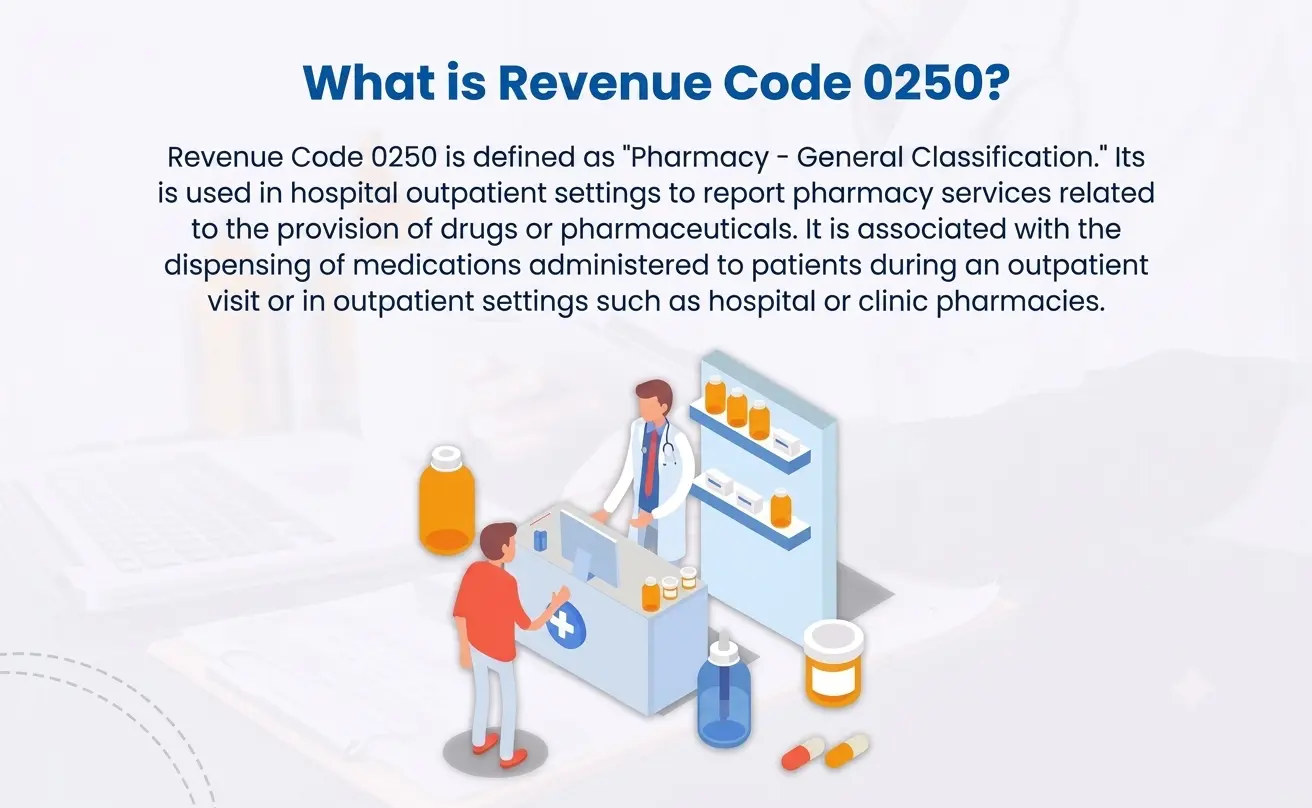
Revenue Code 0250 means Pharmacy, General. It is a Departmental Billing code that is used on Hospital Claims (such as the UB-04 or Electronic 837I) to indicate that a charge originated from the Hospital’s Pharmacy Department. Therefore, this code represents the Pharmacy Department Cost Center as opposed to a particular drug.
In essence, it answers the following question:
Which Hospital Department is billing for this item? ➜ If the answer is the Pharmacy Department, then the code is 0250 reliable general practice medical billing services by medicuremd.
0250 RC identifies only the hospital department that dispensed the medication. The medication itself is identified separately on the claim via the appropriate drug code (typically a HCPCS Code and sometimes an NDC). Therefore, it is not uncommon to see both a Department Code (0250) and a Drug Code (e.g., a HCPCS Code) reported for the same charge.
Example Case Study
A patient comes to the hospital emergency room with a severe kidney infection. While in the ER, the nurse administers an IV Antibiotic along with IV Fluids.
On the claim submitted by the hospital for payment, the charge for the Antibiotic appears on the claim as Revenue Code 0250 because it came from the Hospital’s Pharmacy Department revenue cycle management software.
However, the claim would also report the actual name of the drug that was administered (with its correct code, which is typically a HCPCS Code and could also be an NDC depending on the payer).
Where do you commonly find Revenue Code 0250?
You will most often see 0250 on hospital outpatient claims, such as emergency department visits, outpatient clinics, or infusion centers, because those are common places where patients receive medications.
Although it is less common, you can also expect to see 0250 on inpatient facility claims. This is because 0250 is a Department Code that identifies the Hospital Pharmacy Department, regardless of whether the patient was treated as an inpatient or outpatient. As a general rule, the Setting of Service (i.e., inpatient vs. outpatient) will depend on the type of claim being submitted and/or the Type of Bill, rather than the Revenue Code (0250).
It also helps to know that there are additional pharmacy-specific revenue codes that fall within the “Pharmacy” family of revenue codes designated as 025X. These can vary depending on how your facility tracks pharmacy charges. For example:
- 0251 generic drugs
- 0252 Non-Generic Drugs
- 0253 Take Home Drugs
- 0258 IV Solutions
When to Use Revenue Code 0250
You should use 0250 when ALL of the following are true:
- This is a facility claim from a hospital or hospital department.
- The charge is for a drug or pharmacy-supplied item.
- The facility is billing it under the pharmacy cost center.
When NOT to Use Revenue Code 0250
Do NOT use 0250 in the following circumstances:
- Office, urgent care, or independent clinic billing that is not a hospital facility claim. This code is for institutional billing, not typical professional office billing. For specialized facility insights, see how proper categorization impacts our dedicated family medicine billing processes.
- Non-pharmacy departments, like lab, imaging, or procedures that are not drug related.
- When a payer specifically instructs you to use a different pharmacy revenue code (for example, 0636 for drugs that must be billed with detailed coding).
Also, be careful with “take-home” meds. Many payers have unique “take-home” and self-administered drug payment rules/exclusions. When the facility bills a medication intended for the patient to take home (the facility is billing the payer). It is often billed under 0253.
Revenue Code 0250 Fee Schedule & Reimbursement Rules
Revenue Code 0250 payment rules depend on the payer and the drug.
Medicare often bundles lower-cost outpatient drugs into the overall visit payment, while higher-cost or pass-through drugs may be paid separately using formulas like ASP plus 6% or WAC plus 3%.
Medicaid rules vary by state, but many require both HCPCS and NDC to avoid denials.
Private insurers have no single fixed 0250 rate, but example average amounts include BCBS $34.06, Aetna $140.71, and Cigna $50.00.
Medicare
When it comes to outpatient hospital billing, the medications billed under revenue code 0250 get packaged in one bundle by Medicare. Bundled simply means that Medicare considers the medication as a portion of the overall visit, therefore,reliable general practice medical billing services by medicuremd the hospital does not receive a separate line item payment for that particular medication. The charge for that medication is incorporated into the Ambulatory Payment Classification (APC) for the visit.
When Medicare is more likely to bundle a drug:
A helpful rule of thumb is the drug packaging threshold. As of CY 2025/2026, Medicare continues to use a threshold of $140 per day. Therefore, if the daily cost of a drug is less than $140, it is more likely to be included in the overall visit payment and not paid separately.
When Medicare is more likely to pay for a drug separately:
Medicare is more likely to pay for a drug separately if that drug meets the criteria for separate payment, such as:
- The drug’s total cost exceeds the $140 threshold,reliable general practice medical billing services by medicuremd thereby preventing it from being bundled under the threshold policy.
- The drug qualifies for pass-through status, which is a Medicare designation that allows separate payment for a short duration.
If the drug meets either of those two conditions, then Medicare will typically pay for the drug according to one of its published pricing formulas. Those formulas are:
➜ Average Sales Price (ASP) + 6% for the majority of separately payable Part B medications.
For example, if a drug’s ASP is $100 per unit. Medicare’s base payment method would be:
$$\text{Reimbursement} = \$100 \times 1.06 = \$106$$
(Before any other adjustments that may apply).
➜ Wholesale Acquisition Cost (WAC) + 3%, if no ASP is available.
For example, if a drug’s WAC is $200 per unit and there’s no ASP listed, Medicare will pay:
$$\text{Reimbursement} = \$200 \times 1.03 = \$206$$
(Before any other adjustments that may apply).
Please note that even if the Medicare payment is made using the above mentioned formulas, the actual payment will still be subject to adjustments due to items such as sequestration during times when it is in effect. Therefore, the final allowable amount may be slightly lower than the calculated amount.
Medicaid
As each state has its own unique Medicaid regulations, the specifics regarding what is required of the provider for reimbursement of outpatient services billed under revenue code 0250 can vary greatly. However, some common themes do occur regularly revenue cycle management software.
Note: Many states require both HCPCS and NDC for 0250-type lines
A common reason that claims deny are due to missing drug identifiers. Some state Medicaid Programs request:
- HCPCS drug code (usually a J code)
- 11-digit NDC, plus the proper unit and quantity information
For example, North Carolina Medicaid has indicated that claims with pharmacy revenue codes in the range of 025X and 063X may be denied if the NDC and HCPCS are not documented as required.
Additionally, Maryland Medicaid provides guidance requiring NDC reporting on outpatient claims when billing revenue codes that include 0250.
Medicaid reimbursement for revenue code 0250 often differs from Medicare’s approach. Some Medicaid programs pay outpatient hospital services through systems that rely heavily upon the CPT or HCPCS codes submitted, instead of bundling all services in the same manner as Medicare OPPS.
Private Insurers
The rates that private insurance companies use for Revenue Code 0250’s reimbursement will differ based on the payer’s company and/or where they are located. So there is no single “0250 rate”revenue cycle management software that will apply in all areas. Therefore, providers and hospitals have to look up the fee schedules and contracts for each individual payer, particularly for specialty drugs and treatments.
That said, below are listed several examples of average fee schedule payment amounts for 0250 RC from various payers:
- Blue Cross Blue Shield (BCBS): $34.06
- Cigna: $50.00
- Aetna: $140.71
How to Bill Revenue Code 0250?
Billing pharmacy services using Revenue Code 0250 may seem complex at first. However, there are specific requirements for detail, drug identification,revenue cycle management software and payer-specific billing.
Below is how to correctly bill using Revenue Code 0250.
1). Verify If The Service Is Eligible For Billing
Prior to billing using Revenue Code 0250, you should answer just one question:
“Was this a pharmacy service provided in an outpatient environment?”
Eligibility is the main criterion for billing using Revenue Code 0250.
Use Revenue Code 0250 when the hospital’s outpatient pharmacy dispenses or administers a medication such as an oral medication, injectable medication, IV infusion, biologic medication, or a specialty outpatient medication. This applies across comprehensive institutional paths, including integrated internal medicine operations.
Do not use Revenue Code 0250 when medication is given. At the same time, the patient is an inpatient in the hospital, or when a facility fee is involved, or a laboratory test or procedure is performed. Revenue Code 0250 is like the “home base” for outpatient pharmacy charges.
2). Record All Details Regarding The Medications Provided
Pharmacy billing is detail-oriented, and therefore, any piece of information left off your billing documentation may result in claims being denied by the payer. Consequently, it is essential to record every detail regarding the medication(s) provided.
When documenting the medication(s) provided,revenue cycle management software you should ensure that the following information is recorded:
- The exact name of the drug (generic or brand)
- How the drug was provided (oral, IV, IM injection, infusion, etc.)
- The quantity of the medication the patient received (units, mL, mg, etc.)
- Charge or cost of the medication
- Diagnosis codes (ICD-10), which show why the medication was medically necessary
- CPT/HCPSC codes (identify the drug or the administration of the drug)
- Prescription or provider order information
3). Identify the Correct CPT/HCPSC Code(s)
Billing using Revenue Code 0250 is not sufficient to bill for pharmacy services. Payers (including Medicare and Medicaid) require a drug-specific code linked to the line item being billed. This means:
- HCPSC codes identify the drug itself (for example, J-code for an injectable medication, Q-code for certain biologic medications)
- CPT codes identify administration services (such as IV push, IV infusion, or injection administration)
Revenue Code 0250 identifies the “department,” and the HCPSC/CPT code identifies the “item.” Both codes are needed to allow the payer to understand what drug was provided and how it was administered. Managing these clean code pairs is central to running reliable general practice medical billing services by medicuremd.
1.Stop Losing Revenue to Pharmacy Billing Denials:Partner with MedicureMD Experts.
Managing institutional revenue codes requires specialized knowledge. Let our team audit your crosswalks, check your code pairings, and optimize your overall workflow with advanced revenue cycle management software.
FAQ’s
What is the difference between Revenue Code 0250 and 0636?
Revenue code 0250 is used for general, low-cost, or bundled pharmacy items. Revenue code 0636 is explicitly reserved for high-cost “detailed coding” medications, biologicals, or specialty drugs that require separate reporting of specific HCPCS codes and NDCs for independent reimbursement.
Can I use Revenue Code 0250 on a CMS-1500 form?
No. Revenue code 0250 is an institutional code designed exclusively for facility billing on UB-04 forms or electronic 837I transactions. Professional claims generated on CMS-1500 forms do not use revenue codes; they rely entirely on CPT and HCPCS codes to clear charges.
Why did my 0250 claim line deny for “missing NDC”?
Many payers, particularly state Medicaid programs, mandate the inclusion of an 11-digit National Drug Code (NDC) alongside the revenue code to comply with federal drug rebate programs. If the NDC, unit qualifier, or exact quantity is missing from the electronic loop, the line item will automatically deny.