

If you have ever wondered what is ERA in medical billing and why so many healthcare providers across the United States are talking about it, you are not alone. ERA stands for Electronic Remittance Advice, and it is one of the most important tools in modern medical billing and revenue cycle management. For physician practices, hospitals, clinics, and billing companies across the USA, understanding ERA in medical billing is no longer optional. It is a core part of getting paid accurately and on time.
This guide breaks down everything you need to know about ERA in medical billing, how it works, what it contains, how it differs from a traditional Explanation of Benefits, and why it matters deeply to the financial health of your practice in 2026.
What Is ERA in Medical Billing?
ERA in medical billing refers to the electronic version of a payment explanation that an insurance payer sends to a healthcare provider after processing a medical claim. In simple terms, when you submit a claim to Medicare, Medicaid, or a private insurance company and they process it, they send back a detailed response explaining what they paid, what they adjusted, and why. That response, when delivered electronically, is called an Electronic Remittance Advice.
Before ERA became standard, this information came as a paper document called an Explanation of Benefits, or EOB. The ERA replaced paper EOBs with a standardized electronic file, making it faster, more accurate, and far easier to integrate into billing software systems.
The ERA is transmitted using the HIPAA 835 transaction standard. This is why you will often hear billing professionals refer to ERA files simply as 835 files or 835 transactions. When people ask what is ERA in medical billing, the answer always comes back to this standardized electronic document that tells providers exactly how their claims were handled.
If your practice needs expert help managing ERA enrollment and processing from day one, the team at Contact Us is ready to walk you through every step.
Why ERA in Medical Billing Matters for USA Providers
For any healthcare provider operating in the United States, understanding ERA in medical billing is critical to maintaining a healthy revenue cycle. The U.S. healthcare payment system is complex, involving dozens of payer types, thousands of plan variations, and constantly evolving reimbursement rules. Without a reliable way to track how claims are processed and paid, practices lose money, miss denials, and fall behind on accounts receivable.
ERA in medical billing solves this problem by providing a structured, electronic record of every payment decision a payer makes. Instead of manually reading through paper EOBs and entering payment data by hand, billing teams can receive ERA files directly into their practice management systems and post payments automatically. This saves hours of administrative work every week and dramatically reduces the risk of posting errors.
According to industry data, practices that adopt electronic remittance advice see measurable improvements in payment accuracy, faster cash flow, and reduced administrative overhead. For any USA-based provider serious about revenue cycle performance, ERA in medical billing is a foundational tool.
How ERA in Medical Billing Works: Step by Step
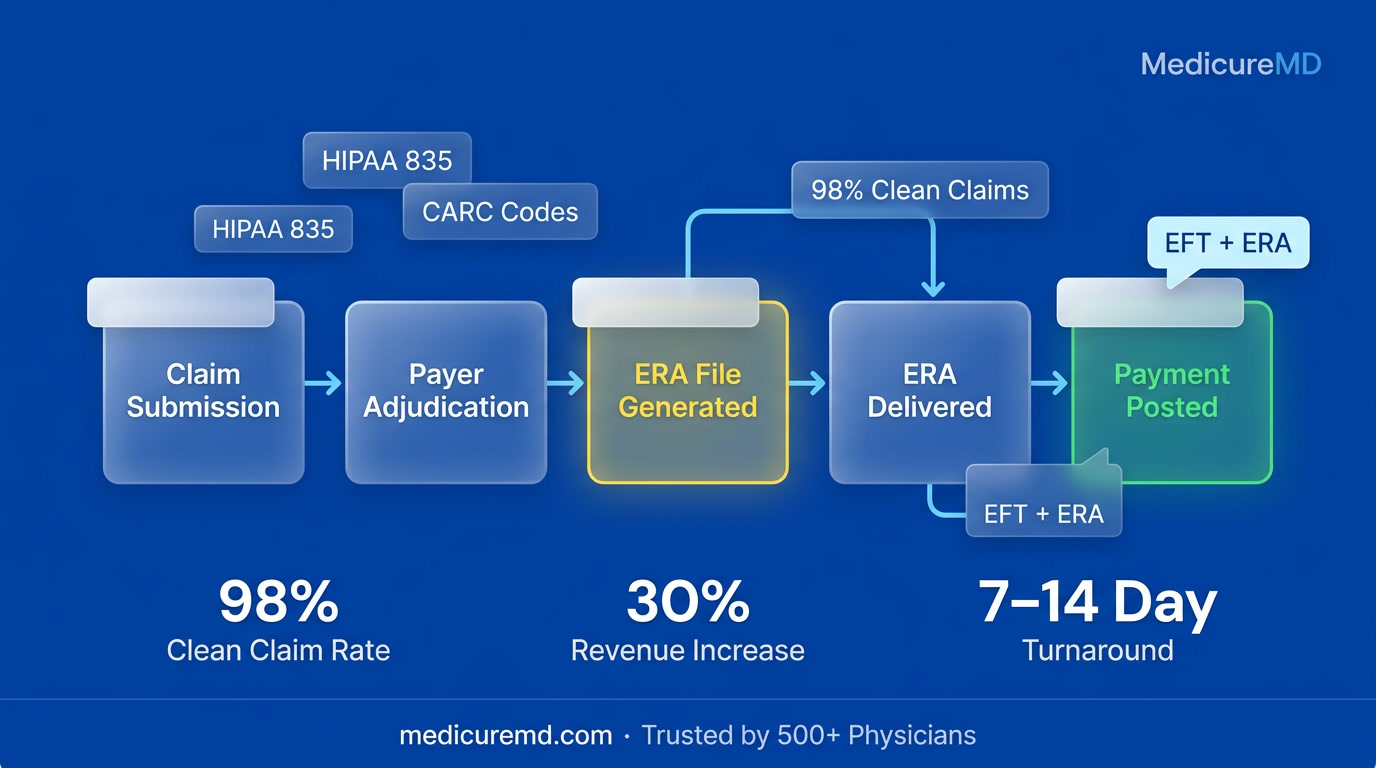
Understanding the ERA process from start to finish helps billing teams use it more effectively. Here is how ERA in medical billing works in a typical USA healthcare setting.
Step 1: Claim Submission
The process begins when a provider or billing team submits a healthcare claim to an insurance payer. This is done electronically using the HIPAA 837 transaction format, which is the standard for claim submission. The claim includes diagnosis codes, procedure codes, provider information, and patient details.
Step 2: Payer Adjudication
Once the payer receives the claim, they review it against the patient’s plan benefits, coverage rules, and medical necessity criteria. During adjudication, the payer decides how much to pay, what to adjust, and whether to deny any part of the claim.
Step 3: ERA Generation
After adjudication, the payer generates an ERA file in the HIPAA 835 format. This file contains a detailed breakdown of the payment decision, including the amount paid, contractual adjustments, patient responsibility amounts, and any denial codes with explanations.
Step 4: ERA Delivery
The ERA is transmitted electronically to the provider or their billing company, either directly from the payer or through a clearinghouse. Most modern practice management systems are set up to receive and import ERA files automatically.
Step 5: Payment Posting and Reconciliation
Once the ERA is received, billing staff or automated systems use the data to post payments to patient accounts, reconcile claims, and identify any discrepancies between what was billed and what was paid. This is where ERA in medical billing truly delivers its value, because it eliminates manual data entry and makes reconciliation fast and accurate.
What Does an ERA Contain?
Every ERA file contains specific data fields that give billing teams a complete picture of how a claim was processed. Knowing what to look for inside an ERA helps your team respond quickly and accurately to every payment decision.
Provider and Payer Information
The ERA identifies both the payer sending the remittance and the provider receiving it, including NPI numbers, tax identification numbers, and payer IDs.
Claim Payment Details
This section shows the total amount paid for each claim, broken down by individual service lines. It also includes the check number or Electronic Funds Transfer reference number so the payment can be matched to the correct bank deposit.
Claim Adjustment Reason Codes
Also known as CARCs, these codes explain why a payer adjusted the payment amount. For example, a CARC code might indicate a contractual adjustment, a coordination of benefits reduction, or a non-covered service. Every billing team working with ERA in medical billing needs to understand common CARC codes to properly interpret payment explanations.
The Centers for Medicare and Medicaid Services publishes the full CARC and RARC code list at Cms. Gov for providers who want to stay updated on every code change throughout the year.
Remittance Advice Remark Codes
Known as RARCs, these codes provide additional detail about specific adjustments or denials. They often accompany CARCs to give a fuller explanation of the payer’s decision.
Patient Responsibility Information
The ERA also shows how much of the claim balance is the patient’s responsibility, including copays, coinsurance, and deductible amounts. This information is used to generate accurate patient statements.
Denial Information
When a claim or service line is denied, the ERA includes the specific denial reason codes and descriptions. This is critical information for the denial management process because it tells the billing team exactly why a claim was rejected and what steps are needed to appeal or correct it.
ERA vs EOB: What Is the Difference?
One of the most common questions billing professionals ask when learning about ERA in medical billing is how it differs from an Explanation of Benefits. Both documents explain how a claim was processed, but they serve different audiences and come in different formats.
An EOB is typically a paper or PDF document that payers send to patients explaining what their insurance covered for a recent visit or procedure. It is written in plain language for non-billing professionals and is not designed for automated processing.
An ERA, on the other hand, is a structured electronic file designed specifically for healthcare providers and billing teams. It follows the standardized HIPAA 835 format, which means it can be imported directly into billing software, processed automatically, and used to post payments without manual intervention.
In short, EOBs are for patients, while ERA in medical billing is for providers and billing departments. As the U.S. healthcare system continues moving toward full digital integration, ERA has largely replaced paper EOBs as the standard for provider-side payment communication.
ERA and EFT: How They Work Together
ERA in medical billing is closely connected to Electronic Funds Transfer, or EFT. While ERA explains the payment, EFT is the mechanism that actually moves money from the payer’s account into the provider’s bank account electronically.
Under HIPAA rules, payers are required to offer both ERA and EFT to providers who request them. When a practice enrolls in both, they receive the payment electronically in their bank account and simultaneously receive the ERA file that explains exactly what that payment covers. This combination makes cash posting faster, more accurate, and fully automated in many modern billing systems.
For USA healthcare providers still receiving paper checks and paper EOBs, enrolling in ERA and EFT together is one of the simplest ways to accelerate revenue cycle performance without major investment. The Council for Affordable Quality Healthcare provides detailed operating rules for ERA and EFT enrollment at Caqh which is a helpful starting point for any practice beginning this process.
For USA healthcare providers still receiving paper checks and paper EOBs, enrolling in ERA and EFT together is one of the simplest ways to accelerate revenue cycle performance without major investment.
Common Challenges with ERA in Medical Billing
While ERA in medical billing offers major advantages, there are some challenges that billing teams encounter, particularly when first implementing the process or managing high claim volumes.
ERA Reassociation in medical billing
One common issue is reassociation, which means matching the ERA file to the correct bank deposit. When multiple payments arrive together, it can be difficult to reconcile each ERA to the right EFT deposit without clear reference numbers. Modern billing software handles most of this automatically, but practices with older systems may need manual intervention.
Interpreting Complex Adjustment Codes
CARC and RARC codes can be difficult to interpret without proper training. Billing staff need ongoing education to stay current with code updates and understand how to respond to each type of adjustment or denial that appears in an ERA.
Payer-Specific Variations
Even though ERA follows the HIPAA 835 standard, individual payers sometimes populate fields differently or use codes in non-standard ways. Billing teams that work with many payers need to be familiar with each payer’s ERA patterns to avoid misinterpretation.
Benefits of ERA in Medical Billing for USA Practices
Despite the learning curve, the benefits of ERA in medical billing far outweigh the challenges. Here is what USA healthcare providers gain when they fully adopt electronic remittance advice.
Faster Payment Posting
Automated ERA posting reduces the time it takes to apply payments to patient accounts from days to hours. This accelerates cash flow and keeps accounts receivable from aging unnecessarily.
Reduced Posting Errors
Manual data entry from paper EOBs is prone to errors. ERA in medical billing eliminates most of this risk by feeding payment data directly into billing systems without human transcription.
Improved Denial Management
Because ERA files clearly identify denied claims and the reasons for denial, billing teams can respond to denials faster and more effectively. Faster denial follow-up means more recovered revenue and fewer write-offs.
Better Compliance
ERA files create a clear, auditable electronic record of every payment and adjustment. This supports compliance with Medicare, Medicaid, and private payer audit requirements, giving providers solid documentation in the event of a review.
Streamlined Revenue Cycle Management
When ERA is integrated with EFT and a modern practice management system, the entire payment cycle from claim submission to bank deposit becomes streamlined and largely automated. This frees up billing staff to focus on higher-value tasks like denial appeals and patient communication.
How to Enroll in ERA in Medical Billing
Enrolling in ERA in medical billing is a straightforward process for most USA providers. Here are the basic steps.
First, contact each of your major payers directly or through your practice management software vendor to request ERA enrollment. Medicare, Medicaid, and most major commercial payers offer ERA enrollment through their provider portals or through a clearinghouse.
Second, make sure your billing software or practice management system is configured to receive and import 835 files. Most modern systems support this out of the box.
Third, consider working with a clearinghouse that aggregates ERA files from multiple payers into a single connection. This simplifies the technical side of ERA management, especially for practices that bill to a large number of different insurance companies.
Many USA practices choose to hand off the entire ERA setup and management process to a professional billing partner. If you want a team that handles everything from ERA enrollment to payment posting and denial follow-up, connect with the billing specialists at Contact Us and get started today.
ERA in Medical Billing and Revenue Cycle Management in 2025
As the U.S. healthcare system continues to evolve, ERA in medical billing is becoming even more central to effective revenue cycle management. CMS continues to expand electronic transaction requirements, and value-based care models demand more granular data about payments and outcomes than paper processes can provide.
Practices that fully leverage ERA in medical billing are better positioned to monitor financial performance in real time, respond quickly to payer changes, and maintain the compliance standards that CMS and private payers require. For billing companies and healthcare providers alike, ERA is not just a convenience; it is a competitive advantage.
Final Thoughts: Understanding ERA in Medical Billing Is Essential
So, what is ERA in medical billing? It is the electronic foundation of modern healthcare revenue cycle management in the USA. It is the document that tells you whether you got paid, how much, why adjustments were made, and what to do about denials. It is the bridge between claim submission and cash in your bank account.
For any physician, hospital, specialty practice, or billing team operating in the United States, mastering ERA in medical billing is one of the most impactful steps you can take toward financial stability and operational efficiency. From faster posting to better denial management and stronger compliance, the advantages are clear and measurable.
If your practice is still relying on paper EOBs or struggling to keep up with ERA processing, now is the time to make the shift. The right billing partner makes ERA adoption simple, fast, and fully managed on your behalf. Reach out at Contact Us and take the first step toward a stronger, faster, and more compliant revenue cycle today.
FAQs
What exactly is the difference between a CARC and a RARC on an ERA?
Claim Adjustment Reason Codes (CARCs) and Remittance Advice Remark Codes (RARCs) are standardized code sets used on an ERA to explain financial variances on a claim. A CARC explains why a payer paid an amount differently than what was billed (e.g., contractual obligations, deductibles, or copayments). A RARC is a supplemental code that provides additional clinical or administrative context to further clarify a CARC or provide specific instructions regarding next steps for a denial appeal.
How does the automated ERA “reassociation” process work with EFT payments?
ERA reassociation is the mechanical process of matching an electronic payment explanation (the 835 ERA file) with the actual monetary deposit in the practice’s bank account (the Electronic Funds Transfer, or EFT). To do this automatically, practice management software utilizes a standardized data field known as the TRN (Transaction Reference Number) segment. When both the banking clearinghouse and the insurance carrier include the identical TRN string in their respective files, the billing software auto-links the payment explanation to the cash received.
Can a clearinghouse split a single ERA file if it contains multiple provider NPIs?
Yes. If an insurance carrier transmits a massive, consolidated multi-provider ERA to a clearinghouse, a modern healthcare clearinghouse can parse and route that file. Using the individual National Provider Identifier (NPI) numbers embedded within the 835 data architecture, the clearinghouse splits the data and delivers the correct, isolated remittance segments directly to each individual provider’s specific practice management system or billing database.
What should a billing team do if an ERA balance does not reconcile perfectly?
When an ERA balance fails to reconcile with the submitted claim amount, the billing team must immediately check the PLB (Provider-Level Adjustment) segment of the 835 file. The PLB segment contains financial adjustments that are not tied to a specific patient claim—such as overpayment recoveries, continuous setup fees, forward balances, or bonus incentives. If the discrepancy isn’t found there, billers must cross-reference the CARC codes to determine if an unexpected contractual write-off or secondary patient responsibility was applied.
Are all insurance payers in the United States legally mandated to provide ERAs?
Under the Health Insurance Portability and Accountability Act (HIPAA) and the Affordable Care Act (ACA) administrative simplification mandates, all covered health plans—including Medicare, Medicaid, and commercial health insurance companies—are legally required to have the capability to transmit Electronic Remittance Advice (835) and Electronic Funds Transfers (EFT) to any healthcare provider who formally requests and completes enrollment for electronic transactions.