
Revenue Cycle Management Steps: 8 Stages From Scheduling to Final Payment
By MedicureMD Billing Team. Reviewed by an AAPC-certified coder.
Revenue cycle management is how a medical practice gets paid, from the moment a patient books a visit to the moment the last balance is closed. If one stage is weak, money leaks out. This guide walks through the revenue cycle management steps in 8 stages, the numbers worth tracking and how to tell when your revenue cycle needs help.
What Is Revenue Cycle Management?
Revenue cycle management (RCM) covers every task that affects how much a practice earns from patient care: scheduling, insurance checks, coding, claims, payments, denials and collections. It is wider than billing. Billing is one part of it. To see the billing side in detail, read our guide to the medical billing process.
Practices that manage the whole cycle, not just claims, usually find problems earlier and get paid faster. Our revenue cycle management services are built around this idea.
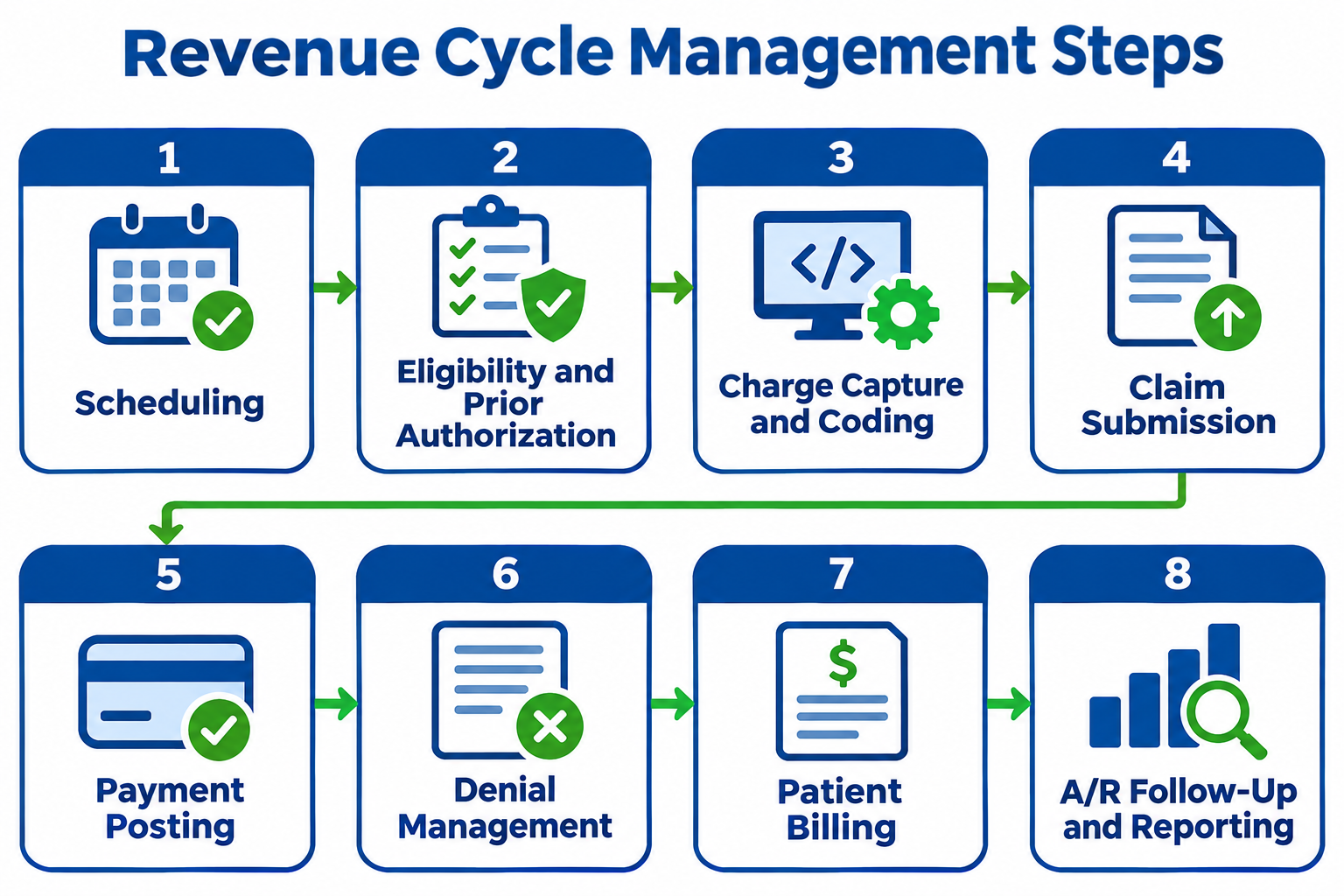
The 8 Revenue Cycle Management Steps
1. Scheduling and pre-registration
The cycle starts before the visit. The front desk collects patient details and insurance information, so the claim starts with correct data.
2. Eligibility and prior authorization
The team confirms active coverage and checks whether the service needs approval from the payer. Missing authorization is a common reason for denials.
3. Charge capture and coding
Everything done during the visit must be recorded and turned into the right codes. Coders certified through AAPC are trained to do this. Missed charges here mean lost revenue.
4. Claim submission
The claim is checked for errors and sent to the payer, usually through a clearinghouse. Clean claims are paid faster.
5. Payment posting
Payments from payers and patients are posted and compared with your contracted rates, so underpayments are caught.
6. Denial management
Each denied claim is reviewed, fixed and appealed before the deadline. Our denial management services focus on this stage.
7. Patient billing and collections
What insurance does not pay is billed to the patient. Clear statements and easy payment options help collect balances sooner.
8. A/R follow-up and reporting
Unpaid claims are followed up, oldest first, and results are reported. The key number here is days in accounts receivable.
Revenue Cycle Management Metrics to Track
- Clean claim rate: the share of claims accepted the first time
- Denial rate: the share of claims denied, and the top reasons
- Days in A/R: how long it takes to get paid
- A/R over 90 days: how much money is stuck in old claims
- Net collection rate: how much of what you are owed you actually collect
Review these every month, along with the revenue cycle management steps above. A number that gets worse over several months usually points to a problem in one specific stage.
Signs Your Revenue Cycle Needs Help
- Denials keep rising and nobody has time to appeal them
- Old unpaid claims keep piling up
- You are not sure what your clean claim rate or A/R days are
- Billing staff are overloaded or have left
- Collections do not match your visit volume
In-House or Outsourced Revenue Cycle Management?
You can run the revenue cycle management steps in-house or outsource them. In-house gives you direct control, but you pay for salaries, software and training, and the work stops when someone is out. Outsourcing hands the cycle to a dedicated team that sends regular reports. Read the pros and cons in our guide to medical billing outsourcing, or see our outsourced medical billing services.
How MedicureMD Handles the Revenue Cycle
MedicureMD is a U.S.-based team of AAPC-certified coders and billers serving 500+ physicians across 30+ specialties. We handle the revenue cycle from eligibility to A/R follow-up and send a report every week. There is no long-term contract, only 30 days notice. Start with a free billing audit and get a written report within 24 to 48 hours.
Frequently Asked Questions About Revenue Cycle Management Steps
What are the steps of revenue cycle management?
The main steps are scheduling and pre-registration, eligibility and prior authorization, charge capture and coding, claim submission, payment posting, denial management, patient billing and collections, and A/R follow-up with reporting.
What is the difference between revenue cycle management and medical billing?
Medical billing is the part that turns visits into claims and gets them paid. Revenue cycle management covers the whole cycle, including scheduling, insurance checks, denials, collections and reporting.
Which revenue cycle management metrics matter most?
Clean claim rate, denial rate, days in A/R, A/R over 90 days and net collection rate are the most useful to review every month.
How long does the revenue cycle take?
It depends on the payer and on whether claims are clean. Claims that are correct the first time are paid faster than ones that need corrections or appeals.
Can I outsource revenue cycle management?
Yes. Many practices hand all or part of it to a billing company, and keep their own EHR and patient care.