Walk into any skilled nursing facility, long-term care community, or hospital floor in the United States on any given morning, and you will find a POC CNA certified nursing assistant already three tasks deep before most people have had their first cup of coffee. A resident needed a brief change. Another asked for help getting dressed. A third had a different color to their skin that the nurse needs to know about. Every single one of those moments has to be documented, and it has to be documented right.
That is the world of POC CNA work. Point of care documentation is not a buzzword or a software feature. For certified nursing assistants across the USA, it is the core of how care gets recorded, communicated, and reimbursed. Getting it right protects patients. Getting it wrong costs facilities money, creates compliance gaps, and can put the CNA’s own professional standing at risk.
This guide covers everything you need to know about POC CNA documentation, from what it actually means on a practical level to how it connects to Medicare reimbursement, what CNAs are expected to chart, and how technology is changing the way frontline care gets recorded.
What POC CNA Means for Certified Nursing Assistants in the USA
POC CNA stands for Point of Care Certified Nursing Assistant. In practical terms, it refers to the process of providing and documenting patient care at the exact time and location where that care is delivered. Instead of performing a task, returning to the nurses’ station, and entering notes from memory at the end of a shift, a CNA using a point of care system documents in real time at the bedside, in the bathroom, at the dining table, or wherever care actually happens.
POC charting refers to the workflow of recording care in real-time at the exact time and location in which the care was provided. Unlike traditional documentation practices in which CNAs view documentation as a separate chore to be completed at the conclusion of a shift, CNAs today utilize apps that enable them to log actions as part of the task itself.
The shift from paper-based, end-of-shift charting to real-time POC CNA documentation has changed how certified nursing assistants work in fundamental ways. The data they enter is no longer just an administrative record. It feeds directly into clinical decision-making, care planning, regulatory compliance, and financial reimbursement for the facility.
For a deeper look at how frontline POC CNA documentation connects to the broader revenue cycle, MedicureMD’s guide on point of care for CNA breaks down exactly how CNA charting impacts billing and reimbursement in long-term care settings.
What POC CNA Systems Require CNAs to Document Every Shift
A CNA is not responsible for clinical assessments or treatment decisions. That is the territory of registered nurses and physicians. What CNAs do document covers the daily, direct, hands-on care that no one else on the team provides in the same volume or consistency.
POC CNA ADL Documentation and Why It Drives Medicare Payments
ADL documentation is at the center of POC CNA charting. Every time a CNA assists a resident with bathing, dressing, grooming, toileting, eating, or transferring, that assistance needs to be recorded with a level of detail that accurately reflects how much help the resident required.
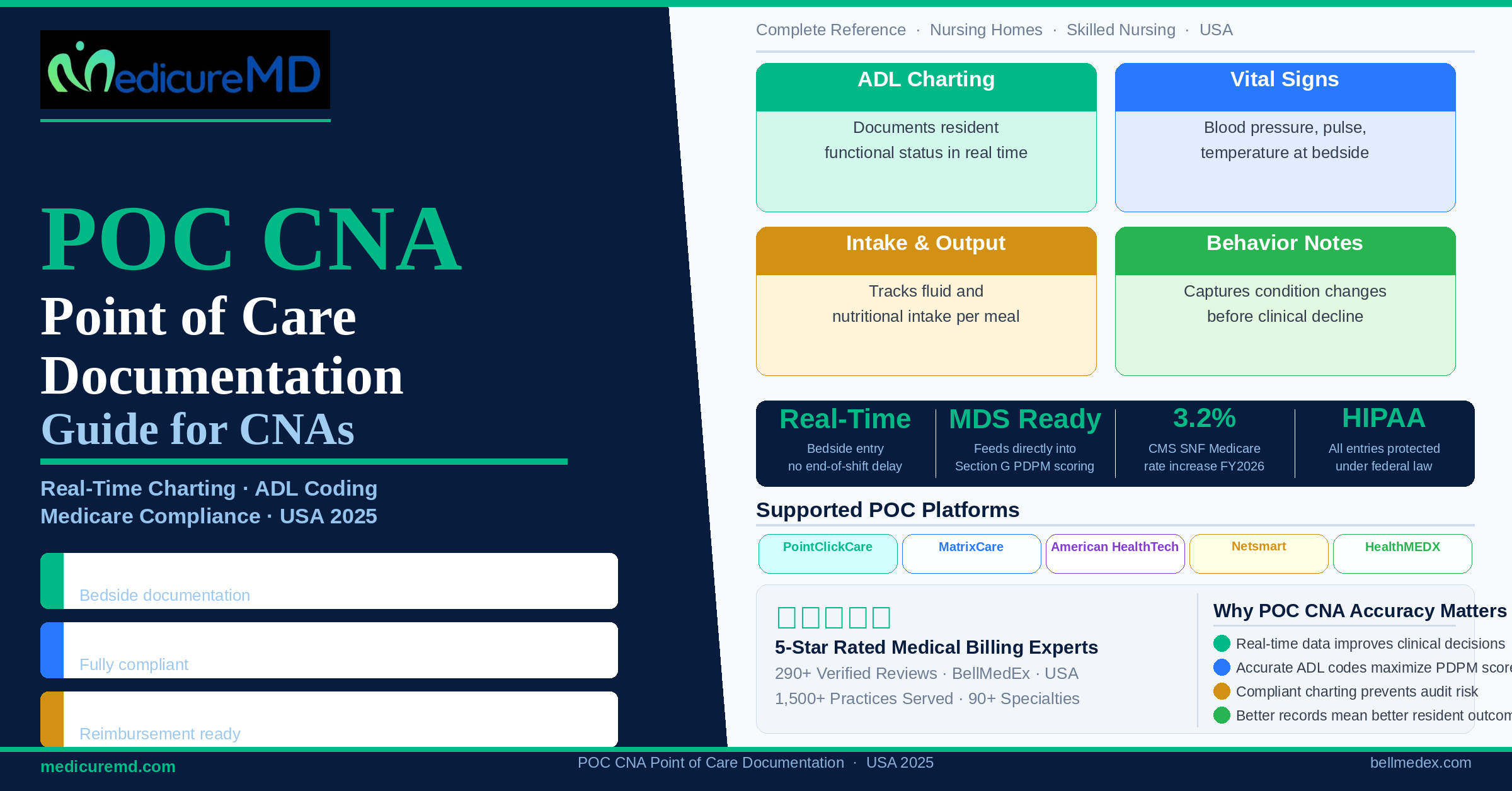
POC documentation allows CNAs to record a wide range of patient data, including vital signs such as blood pressure, pulse, temperature, and respiration rate, activities of daily living including bathing, feeding, dressing, and toileting assistance, intake and output monitoring, skin care noting changes in skin condition, and mobility recording details about patient transfers or ambulation.
The way ADLs are coded matters enormously. In a Medicare-certified skilled nursing facility, ADL data flows directly into the Minimum Data Set assessment, which determines the Patient-Driven Payment Model score, which determines how much Medicare pays the facility. ADL coding is not just a checkbox. It is the data that flows into MDS Section G, which flows into the RUG or PDPM score, which flows into how much Medicare pays the facility. Every tap has a dollar value behind it. Every missed entry is money the facility cannot bill for and care the resident might not get next quarter.
Vital Signs Recorded Through POC CNA Platforms
Blood pressure, pulse, temperature, respiratory rate, and oxygen saturation are all part of the POC CNA documentation workflow in most facilities. Recording these at the time of measurement rather than from memory hours later is one of the clearest benefits of point of care systems. A reading that gets entered four hours late is not just inaccurate. It can be the difference between a clinical team catching a decline in time and missing it entirely.
How Point of Care CNA Charting Captures Behavioral and Condition Changes
CNAs spend more direct time with residents than any other member of the care team. That proximity makes them the first line of observation for changes in condition, behavior, or mental status. Documenting these changes in real time through a POC CNA system ensures the information reaches the nursing team while it is still actionable.
CNAs serve as the primary observers of patients’ physical and emotional condition. By recording vital signs, noting pain levels, and identifying changes in mental or physical status, CNAs create a critical communication bridge between patients and the broader healthcare team. Accurate documentation at the point of care ensures that nurses, physicians, and administrators receive timely and reliable information to guide clinical and financial decisions.
Intake and Output Tracking in POC CNA Documentation
Fluid and nutritional monitoring is particularly important in long-term care settings where dehydration and malnutrition are significant risks. POC CNA documentation captures what a resident ate and drank at each meal, in real time, rather than relying on end-of-shift estimates that are rarely accurate.
How POC CNA Technology Works on a Typical Nursing Shift
The technology behind POC CNA systems has evolved rapidly over the past decade. Most facilities now use tablets, wall-mounted kiosks, or computer-on-wheels units positioned throughout the unit so CNAs can document without leaving the resident’s space.
The POC CNA Workflow From First Task to End of Shift
The POC CNA system works by combining caregiving tasks with real-time documentation using technology. The CNA assists the resident with daily activities such as bathing, dressing, or mobility. Using a tablet or mobile device, the CNA documents the care immediately. The data is uploaded to the electronic health record system. Nurses and physicians can instantly view updates and make decisions. This workflow eliminates delays and improves communication across the healthcare team.
From the CNA’s perspective, the shift starts with pulling up their assignment list on the device. Each resident’s planned care tasks appear as a checklist. As the CNA completes each task, they check it off, add any relevant observations, and move on. The documentation takes seconds rather than minutes because the system is built around the actual workflow rather than forcing the CNA to translate care into administrative language from scratch.
Common POC CNA Platforms Used in USA Long-Term Care Facilities
PointClickCare is the most widely used POC CNA platform in skilled nursing and assisted living facilities across the United States. PointClickCare Point of Care CNA refers to the mobile and bedside documentation technology designed explicitly for Certified Nursing Assistants within the PointClickCare ecosystem. This software enables CNAs to record care activities directly at the patient’s bedside using handheld devices such as tablets or smartphones. By capturing real-time data, the system enhances accuracy and timeliness of patient records, which is vital in fast-paced healthcare environments.
MatrixCare, American HealthTech, and Netsmart are also used by long-term care operators throughout states including Texas, Florida, California, Ohio, New York, Pennsylvania, and Illinois. The platforms differ in interface design, but the underlying POC CNA workflow is consistent: document at the bedside, in real time, with every entry timestamped and tied to the resident’s electronic health record.
Why Accurate POC CNA Documentation Directly Affects Medicare Reimbursement
This is the part of POC CNA that most CNAs are not explicitly taught in training but that facility administrators think about constantly. Accurate, timely CNA documentation is not just a quality-of-care issue. It is a revenue issue.
Medicare reimbursement for skilled nursing facilities under the Patient-Driven Payment Model is based heavily on the documented functional status of residents. If a resident requires extensive assistance with three or more ADLs but the POC CNA documentation only captures minimal assistance due to vague or incomplete charting, the facility is classified at a lower payment category than the resident’s actual care needs warrant. That difference, multiplied across a census of 80 or 100 residents, represents significant revenue loss on every billing cycle.
Point of care documentation increases financial results through more complete and accurate compilation of care provided, ensures consistent care delivery, and allows providers to properly bill for the care provided. Accurate capture of ADLs and full integration with MDS assessments ensures service providers can maximize reimbursement for services.
CMS increased the net Medicare payment update for skilled nursing facilities from 2.8 percent to 3.2 percent in the FY 2026 final rule. That means there is more money available in the system, but only for facilities whose documentation accurately supports the level of care they are providing. A POC CNA team that consistently under-documents is leaving real federal dollars uncaptured.
For facilities looking to connect frontline CNA documentation practices to stronger billing and compliance outcomes, MedicureMD’s resource on POC CNA and frontline documentation provides practical guidance on closing the gap between care delivery and revenue capture.
You can also review the official CMS guidelines on skilled nursing facility billing requirements directly at CMS Skilled Nursing Facility Billing and Coverage to understand how documentation standards connect to reimbursement criteria.
Common POC CNA Documentation Errors That Cost Facilities Revenue
Even experienced CNAs make documentation mistakes. Knowing the most common ones helps you build habits that protect both the resident and the facility.
Delaying POC CNA Entries Until the End of Shift
This is the single most common POC CNA error and the one that causes the most downstream problems. When a CNA waits until the end of a 12-hour shift to enter ADL data, the accuracy of that data degrades significantly. Times are estimated, levels of assistance are rounded, and subtle observations get forgotten entirely. Real-time documentation is the only way to ensure the record accurately reflects what happened.
Vague Language That Undermines Point of Care CNA Charting
“Resident tolerated care well” does not tell a nurse, a physician, or a state surveyor anything useful. POC CNA documentation should describe what was done, how the resident responded, and any deviations from the care plan. If a resident refused a bath, document that the resident refused and note the reason if they provided one. If a resident ate poorly, document the percentage consumed and any behavioral observations.
Documentation mistakes are common but preventable. These errors can create compliance risks and undermine patient safety. POC documentation is a legal record. In audits, investigations, or legal cases, CNA charting is often reviewed to verify whether care was delivered as required.
Incorrect ADL Coding in POC CNA Systems
ADL coding in most POC CNA systems uses a standardized scale that ranges from independent to total dependence, with several levels of assistance in between. Many CNAs default to the middle of the scale out of habit or uncertainty rather than accurately reflecting what the resident actually needed. Training on ADL coding should be part of every new CNA orientation and refreshed regularly.
Skipping Behavioral Observations in POC CNA Charting
CNAs sometimes feel that behavioral or cognitive observations are outside their scope. They are not. A resident who seems more confused than usual, is resisting care when they normally cooperate, or has expressed pain during ADLs needs that observation documented in the POC CNA system immediately. These observations are often the first data point in a clinical decline that the nursing team needs to respond to.
For further coding and documentation standards that support compliant CNA charting, the AHIMA health information management resources provide practical reference material for long-term care documentation teams.
HIPAA and Legal Obligations in POC CNA Documentation
POC CNA documentation is protected health information under HIPAA. Every entry a CNA makes in the electronic health record is subject to federal privacy requirements that restrict access, sharing, and retention of that data.
In practical terms, this means CNAs should never share resident information verbally in public areas of the facility, never photograph or screenshot patient records on personal devices, and always log out of the POC CNA system when stepping away from a device. HIPAA violations in long-term care settings are taken seriously by state and federal regulators, and CNAs can face personal disciplinary consequences separate from any facility-level penalties.
The HHS HIPAA guidance for healthcare workers outlines the full scope of obligations for anyone who handles protected health information, including CNAs working in any care setting across the USA.
The Future of POC CNA Charting in USA Long-Term Care
Point of care technology for CNAs is continuing to evolve quickly. Voice-activated documentation, biometric vitals monitoring, and AI-assisted charting prompts are already being piloted in facilities across the country. The goal in every case is the same: reduce the documentation burden on the CNA so they can spend more time on direct care while simultaneously improving the accuracy and completeness of the clinical record.
As technology evolves, CNA POC charting will continue to become more streamlined, but accuracy and professionalism will remain essential.
Regardless of what the technology looks like five years from now, the fundamental principle behind POC CNA work will not change. Care that is not documented is care that cannot be verified, reimbursed, or built upon. The CNA who documents well is not just doing paperwork. They are building the foundation of everything else that happens in that resident’s care.
For long-term care facilities, home health agencies, and skilled nursing providers across the United States that want to strengthen the connection between POC CNA documentation and revenue cycle performance, MedicureMD provides the expertise and support to make that connection work at every level of the organization.
FAQs
What exactly does POC mean when applied to a CNA’s daily workflow?
POC stands for Point of Care. For a Certified Nursing Assistant (CNA), this means documenting a resident’s care at the exact time and location it is given—whether that is right at the bedside, in the dining room, or in the bathroom. Instead of waiting until the end of a long shift to type notes from memory, the CNA uses a tablet, mobile device, or wall-mounted kiosk to log tasks like vitals, meals, and mobility in real time as they happen.
Why does CNA ADL documentation have such a massive impact on Medicare reimbursement?
Activities of Daily Living (ADLs)—such as bathing, eating, dressing, and toileting—are the primary drivers of reimbursement in skilled nursing facilities under Medicare’s Patient-Driven Payment Model (PDPM). The data a CNA logs flows directly into the facility’s Minimum Data Set (MDS) assessments. If a CNA provides extensive hands-on help but accidentally logs it as minimal assistance, the facility is placed into a lower payment bracket, causing substantial, compounded revenue loss.
What is the difference between logging a virtual visit and logging POC CNA data?
While both utilize electronic health systems, they track entirely different clinical elements. Telehealth billing relies on specific location codes (like POS 10 for a patient’s home) to dictate physician fee schedules. POC CNA charting, on the other hand, does not deal with insurance location codes; it tracks the granular, day-to-day physical assistance, behavioral changes, and fluid intake of a resident already residing within a care facility.
Can a CNA get into legal trouble for poor or delayed point of care charting?
Yes. A patient’s electronic health chart is a legal document. In the event of a state audit, a patient injury investigation, or a lawsuit, the timestamps and specific details of CNA charting are heavily reviewed. Intentionally falsifying records, consistently charting from memory hours after a shift ends, or failing to report a visible change in skin or behavior can result in a CNA losing their state certification or facing personal legal liability.
What are the most common platforms used for POC CNA documentation in the US?
The most widely used platform in American long-term care and skilled nursing facilities is PointClickCare (specifically its Point of Care module). Other major software systems frequently used across states like Texas, Florida, and Ohio include MatrixCare, American HealthTech, and Netsmart. While the screen layouts vary, they all utilize a checklist-style interface optimized for mobile devices and bedside kiosks.
How does real-time intake and output tracking protect residents clinically?
Dehydration and malnutrition are major clinical risks in long-term care. When a CNA logs exactly how much a resident ate or drank immediately after a meal, the data is instantly accessible to the nursing and dietary teams. If tracking is delayed until the end of a 12-hour shift, staff often input rounded guesses, which can mask a dangerous downward trend in a resident’s fluid or food consumption until a medical emergency occurs.