List of EMR Systems in Healthcare: Compare Your Options With MedicureMD
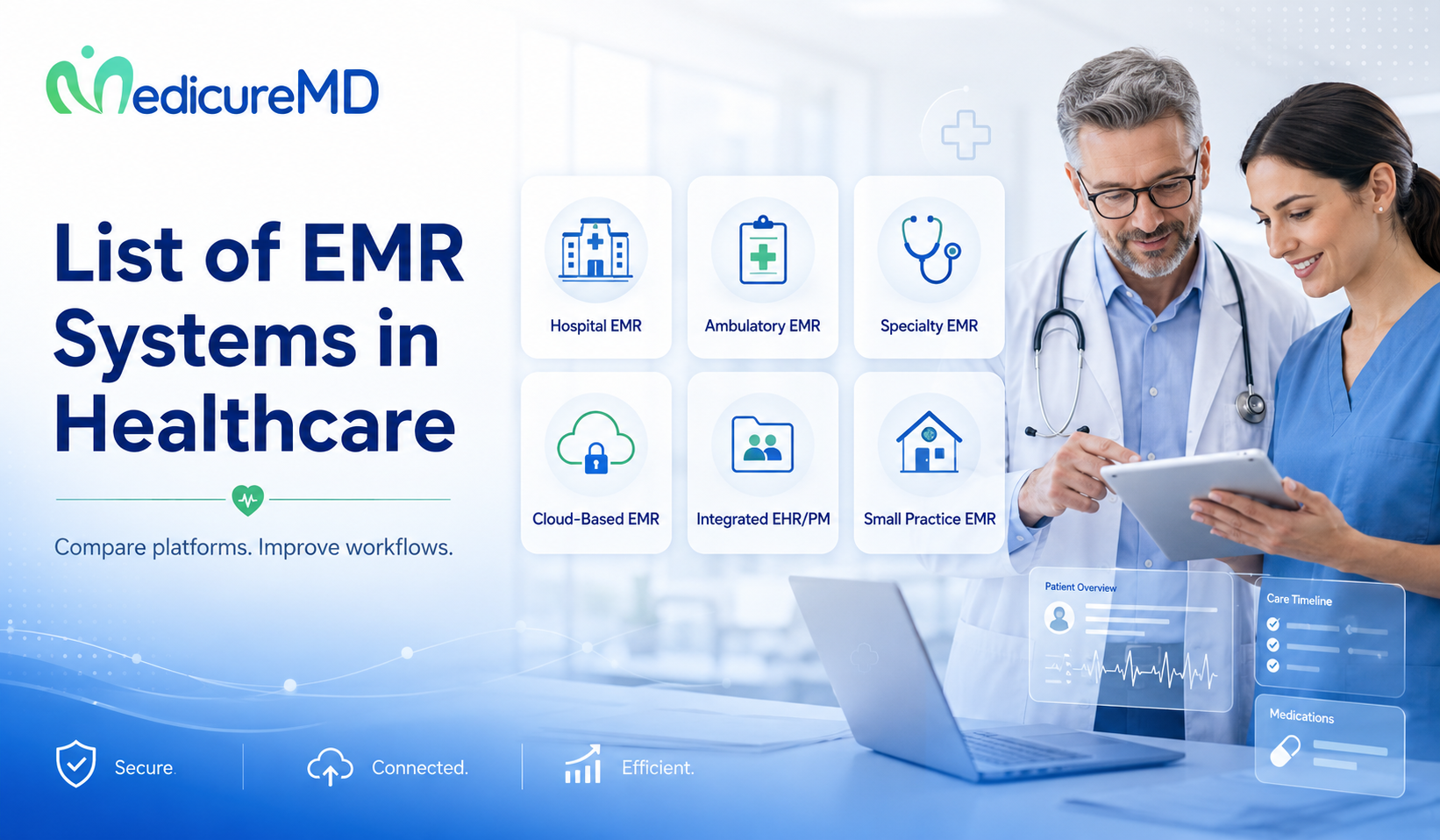
A list of EMR systems in healthcare includes electronic record platforms used by solo physicians, specialty practices, behavioral health providers, medical groups, and large healthcare organizations to manage clinical information and connected practice workflows.
For most US practices the buying question has changed. Physicians no longer need to ask whether electronic records have become standard. Federal health IT data shows that 95% of US office-based physicians used an EHR in 2024 and 91% used a certified EHR. Doctors now need to decide whether their current system supports the clinical-to-payment workflow their practice actually needs. Review the latest federal physician EHR adoption data.
That difference matters for a 3-provider practice as much as it does for a 50-provider group. A physician may like the documentation screen while the billing staff spends hours correcting missing insurance fields or unmatched encounters. Software selection and revenue cycle performance should therefore sit in the same conversation.
MedicureMD approaches that problem from the billing side. Rather than requiring a medical practice to replace the EHR it already knows, MedicureMD states that its billing specialists work across major EMR and EHR systems and build billing workflows around the practice’s existing technology. This makes the EHR question less about replacing software and more about making the current system work better with billing.
Which EMR and EHR Systems Does MedicureMD Work With?
MedicureMD publicly lists 12 medical software and EHR systems that its medical billing team works with. The list covers systems used across independent practices and behavioral health settings as well as larger medical groups.
MedicureMD currently names the following platforms on its medical billing services page. The order below does not represent a ranking.
| System | System | System |
|---|---|---|
| AdvancedMD | Tebra/Kareo | athenahealth |
| eClinicalWorks | DrChrono | CareCloud |
| SimplePractice | TherapyNotes | Office Ally |
| NextGen | Epic | Cerner / Oracle Health |
This list matters because a practice may already have 3 years of patient records and trained employees inside one of these platforms. Replacing the EHR simply because the billing workflow performs poorly can create a second expensive problem. MedicureMD instead reviews the existing EHR environment and builds billing operations around it.
MedicureMD’s current medical billing page states that onboarding includes an implementation questionnaire covering the practice specialty and EMR requirements. Its team then requests access to the existing EHR and develops workflow SOPs from charge capture through claim submission.
That model creates a clear relationship: **your EHR stores and moves clinical encounter information while MedicureMD connects that information with the billing workflow.** If the encounter reaches billing correctly then claims can move forward. If information is missing then the team can trace the issue back to the source workflow.
Why Choose MedicureMD for EMR and EHR Billing Support?
MedicureMD gives practices an EHR-flexible billing model rather than tying billing support to one software product. This approach can matter when a 5-provider group already has years of data and staff training invested in its current platform.
MedicureMD reports that its EMR/EHR services support 500+ physicians across 40+ specialties. The company also reports 1,100+ certified medical billers and coders and an up to 98% first-pass clean claim rate. These are company-reported performance figures rather than independent industry benchmarks.
For a buyer the more important question is how those resources connect with daily work. A billing partner should understand where an encounter starts and when the note closes. It should also know how charges enter billing and what happens when a payer rejects the claim.
A MedicureMD relationship can focus on 4 areas:
Existing EHR support: Build the billing process around the platform already used by the medical practice.
Charge-to-claim workflow: Connect documented encounters with coding review and claim preparation.
Denial follow-up: Trace failed claims back to registration or coding and payer requirements.
Revenue reporting: Give administrators visibility into claims and payments plus aging balances.
A practice does not need another generic software feature list if its real problem involves 80 claims sitting in A/R. It needs to know whether the people managing billing can work effectively inside the system that contains those encounters.
Practices can review MedicureMD’s EMR and EHR support services when they want to connect existing medical software with a structured billing process.
How Should Doctors Compare EHR Companies Before Choosing a Billing Partner?
Doctors should compare EHR companies separately from the company that manages the revenue cycle. One vendor may supply the clinical software while MedicureMD manages billing activity inside or alongside that environment.
This distinction prevents a common buying mistake. A practice may choose an EHR because it has strong documentation tools and then assume the same system will automatically solve denial management or A/R follow-up. Software can move information but people still need to work exceptions and payer responses.
Practice size also affects the decision. ONC data for 2024 shows that certified EHR adoption reached 79.9% among solo physicians. The rate increased to 92.9% in practices with 4 to 10 physicians and 98.5% among groups with 51 or more physicians. Larger groups also showed a stronger preference for market-leading EHR developers.
That does not mean a 2-provider office should copy the technology strategy of a 100-provider medical group. The smaller practice may care more about fast charting and affordable setup. The larger group may need permissions across several locations and hundreds of users.
MedicureMD can sit across those different technology choices because its service model focuses on billing operations. Whether the practice works in AdvancedMD or athenahealth or eClinicalWorks, the revenue cycle still needs accurate demographics and complete encounters plus claim follow-up.
What Should Electronic Medical Records Software Connect With?
Electronic medical records software should connect clinical documentation with patient data and downstream administrative workflows. If a physician closes 30 notes today but 4 encounters fail to reach billing then the practice has a revenue problem even though the clinical record is complete.
The connection begins before the physician sees the patient. Registration captures demographics and insurance information. The clinician then documents the encounter. Billing uses those details to build the claim. Each step depends on information created during an earlier step.
Consider one simple error. A front-desk employee updates a new insurance member ID in the practice system but the billing record still carries the previous number. The physician may complete the visit correctly while the payer later rejects the claim for member information.
This is why MedicureMD’s value should not be framed as another EHR product. The stronger commercial message is that MedicureMD supports the financial workflow **around and through** the practice’s electronic medical records software.
The practice can keep a system its clinicians know while bringing billing specialists into the patient-to-payment process. That reduces the pressure to launch an expensive EHR replacement simply because claim management needs attention.
What Makes Top Electronic Health Record Systems Work Better With Billing?
Top electronic health record systems create more business value when clinical data reaches the billing workflow without repeated manual entry. The software does not need to perform every revenue cycle task itself. It needs to give authorized billing staff the correct information at the correct point.
A practice handling 1,000 encounters each month can feel even a small workflow failure. If 5% of encounters require manual correction then employees must reopen 50 patient records before those claims can move forward.
The same issue appears after submission. An EHR may store the original encounter but billing staff still need a workflow for payer responses and denials. If a payer rejects a claim for an authorization issue then the billing team must connect that denial back to the patient record and correct process.
This is where a service-first model can outperform a software-only decision. MedicureMD reports expertise across major EHR environments while also handling claims and denials plus A/R and payment posting.
Doctors comparing the top electronic health record systems should therefore ask 2 questions. First ask whether clinicians can document efficiently. Then ask whether the system gives the billing partner the data needed to complete the revenue cycle.
Does MedicureMD Replace Your Current EMR or EHR?
MedicureMD’s current positioning focuses on EMR/EHR billing support rather than forcing practices to replace their current clinical platform. Its onboarding process specifically refers to receiving access to the client’s existing EHR system.
That distinction can reduce disruption. A 10-provider practice may have hundreds of templates and years of patient records in its current environment. Replacing that system can require migration and training plus workflow redesign.
If the real issue involves billing then changing the clinical platform may not address the source of the problem. The practice may instead need better claim follow-up or eligibility review. It may also need coding support or tighter A/R management.
MedicureMD can assess that layer while the clinical staff continues working in a familiar environment. This model can be especially relevant for practices already using one of the 12 platforms MedicureMD publicly lists.
The commercial question changes from “Which new EHR should we buy?” to “Can our current EHR support a better revenue process when the right billing team works with it?”
Why Should Practices Check EHR Certification Before Choosing Software?
Practices should check certification when certification matters to their use case because a vendor name alone does not confirm the status of every product version. ONC maintains the Certified Health IT Product List for this purpose.
ONC describes the CHPL as the authoritative list of health IT products successfully tested and certified through the federal Health IT Certification Program. A buyer can search the exact product rather than relying only on sales language. Search the official Certified Health IT Product List.
Certification still does not tell a 4-provider practice whether staff will like the scheduling workflow. It also does not prove that the billing handoff will match the practice’s process. Certification and workflow fit answer different buying questions.
A doctor should therefore verify the system first and then test it. MedicureMD can address the second part from the billing side by reviewing how encounter information moves from the selected EHR into claims and payment follow-up.
How Does Practice Size Change the Right EMR Choice?
Practice size changes the right EMR choice because a solo physician and a 60-provider organization manage different levels of access and reporting plus workflow complexity. Current federal data shows clear adoption differences between those groups.
A solo physician may value fewer screens and faster training. A large medical group may need location controls and department permissions. It may also need centralized reporting across several specialties.
The billing environment changes too. A solo provider may create 300 claims in one month while a multi-provider group can create several thousand. Higher claim volume increases the effect of even a 2% workflow problem.
This is why MedicureMD should appear in the buying discussion before a practice changes systems. A billing review can identify whether the current EHR actually causes the problem or whether the failure begins in claim follow-up or coding and payer work.
A practice that correctly identifies the problem can make a smaller and more focused investment.
What Should Doctors Test Before Switching EMR Systems?
Doctors should test real patient-to-payment scenarios before switching EMR systems. A 45-minute vendor demo can look impressive while hiding steps that staff will repeat 100 times every week.
Use the same 4 tests with each shortlisted system:
* Register 1 new patient and update that patient’s insurance information.
* Complete 1 common visit from chart opening through the signed note.
* Move 1 completed encounter into the billing process and verify its status.
* Export 1 patient record to understand how data can leave the system.
Include both clinical and billing employees in the test. A physician may notice 4 extra documentation clicks while a biller notices that the diagnosis does not flow correctly into the charge.
A MedicureMD billing review adds another perspective. The practice can ask whether its current platform already supports the required workflow before spending money on migration.
If the existing EHR can pass complete encounter data into billing then the practice may need workflow correction rather than software replacement.
How Does MedicureMD Onboard a Practice With an Existing EHR?
MedicureMD uses an onboarding process that starts with practice information and moves into existing-EHR access and customized billing workflows. Its current medical billing page describes a 5-stage onboarding structure.
The process starts with a welcome call. MedicureMD then collects information about the specialty and provider list plus EMR requirements. The billing team uses that information to understand how the current environment works.
During onboarding MedicureMD requests access to the existing EHR. That step matters because the team can see how the practice captures data instead of designing billing rules around assumptions.
The team then establishes workflow SOPs covering steps such as charge capture and claims submission. The final stage moves the agreed billing process to go-live.
For a practice already using Epic or eClinicalWorks or one of the other systems on MedicureMD’s published list, this approach can preserve the clinical environment while changing how billing work gets managed.
Why Will EMR Interoperability Matter More After 2026?
EMR interoperability will matter more because US healthcare policy continues to push provider and payer systems toward structured data exchange. Practices choosing software today should consider how the system will exchange information over the next several years.
CMS finalized several API requirements for impacted payers with compliance dates generally beginning January 1 2027. These include Provider Access and Prior Authorization APIs that expand electronic exchange between payers and authorized healthcare providers. Review the CMS Interoperability and Prior Authorization requirements.
A medical practice does not need to become a software engineering company to prepare. It does need to ask whether its EHR can exchange data through current standards and interfaces.
Billing teams will also need access to better structured information. Prior authorization details and claim-related records increasingly move through electronic workflows. A disconnected practice can create more manual work even if the physician’s documentation system functions well.
MedicureMD’s platform-flexible support gives the company a useful position here. It can work with the EHR environment chosen by the provider while managing the financial workflow around that system.
Should You Change Your EHR or Fix the Revenue Workflow First?
A practice should identify the source of the revenue problem before replacing its EHR. If claims fail because staff do not work denials for 30 days then a new clinical record system may not solve the problem.
Start with 3 months of revenue data. Review claim rejections and denials. Then examine charge lag and A/R over 90 days.
If errors begin because encounter information does not reach billing then system integration deserves attention. If the data arrives correctly but claims remain untouched then the practice likely needs better revenue cycle management.
This distinction can save a medical group from an expensive migration that treats the symptom rather than the cause.
MedicureMD can review both sides of that handoff through its EMR/EHR support and medical billing workflow. Practices can also review MedicureMD’s guide to EMR vs EHR for US healthcare providers before making a technology decision.
Frequently Asked Questions About EMR Systems and MedicureMD
Which EMR Systems Does MedicureMD Work With?
MedicureMD publicly lists 12 systems including AdvancedMD and Tebra/Kareo plus athenahealth and eClinicalWorks. The list also includes DrChrono and CareCloud plus SimplePractice and TherapyNotes. Office Ally and NextGen plus Epic and Cerner/Oracle Health also appear on its current medical billing services page.
Does MedicureMD Sell Its Own EHR Software?
MedicureMD currently positions its EMR/EHR offering as billing and workflow support across existing healthcare software rather than presenting a proprietary EHR product. Its onboarding process asks for access to the practice’s existing EHR. This approach lets a provider keep familiar software while MedicureMD manages billing-related workflows around it.
Can MedicureMD Work With Epic or eClinicalWorks?
Yes. MedicureMD currently lists both Epic and eClinicalWorks among the medical software and EHR systems its medical billing team works with. A practice should still discuss its exact configuration during onboarding because workflows and interfaces can differ between organizations even when they use the same named EHR platform.
Can a Practice Keep Its Existing EHR When Outsourcing Billing?
A practice can often keep its existing EHR when the billing partner can work within that environment. MedicureMD specifically asks for access to the client’s existing EHR during onboarding. The team then creates billing SOPs around the practice workflow so the organization does not automatically need to migrate its clinical records.
How Should Doctors Choose Between EHR Companies?
Doctors should compare EHR companies against real clinical and billing workflows rather than choosing from a generic ranking. Test at least 3 common encounters and review the 3-year cost. Also check certification when relevant. Include clinical and billing staff because both groups use information created inside the patient record.
Why Does EMR Billing Integration Matter?
EMR billing integration matters because clinical data starts the claim workflow. If a practice completes 1,000 monthly encounters and 5% reach billing with missing information then staff must manually review 50 accounts. Better data flow can reduce that rework before claims enter payer processing.
What Should Your Practice Do Next?
Your practice should first decide whether it actually needs a new EMR or needs better billing performance from the system it already has. Review the last 90 days of claim rejections and denials plus charge lag and A/R before committing to software migration.
If the current EHR supports daily clinical work then test the financial handoff. Confirm whether signed encounters and diagnoses plus insurance details reach billing correctly. A problem found at this stage may need workflow repair rather than a new platform.
If your practice already uses AdvancedMD or athenahealth or eClinicalWorks or Epic or another major EHR, MedicureMD can review how that existing environment connects with billing. Its model allows clinical software and revenue cycle support to remain separate while still working toward the same patient-to-payment outcome.
As data exchange requirements grow after 2026, practices will need both reliable EHR technology and disciplined revenue workflows. MedicureMD’s platform-flexible approach gives physicians a practical next step: keep the clinical system that works and strengthen the financial process around it.