

Endocrinology Medical Billing for Accurate Claims and Stronger Revenue
Endocrinology medical billing is the specialty revenue cycle process used to code and bill endocrine care such as diabetes management, thyroid services, hormone disorders, continuous glucose monitoring, chronic care, and related physician services.
An endocrinologist may manage a patient with type 2 diabetes during one visit and review continuous glucose monitor data during the next. Another patient may need thyroid imaging or ongoing osteoporosis treatment. Each case can create a different coding path. That makes specialty knowledge important from the first charge through final payment. MedicureMD identifies diabetes technology billing, thyroid and parathyroid procedures, hormone testing, and chronic care as common endocrinology billing areas.
The size of the diabetes population also makes revenue workflow important for endocrine practices. The CDC’s updated National Diabetes Statistics Report estimates that 40.1 million people in the United States had diagnosed or undiagnosed diabetes in 2023. That equals about 12% of the population. The same report estimates 115.2 million US adults have prediabetes. Review the CDC National Diabetes Statistics Report.
A large patient population does not automatically create healthy practice revenue. The clinical encounter must produce the right documentation. The billing team must then match that record with the correct service and payer rules. If one link breaks, an otherwise valid $150 or $300 encounter can move into a denial queue rather than payment.
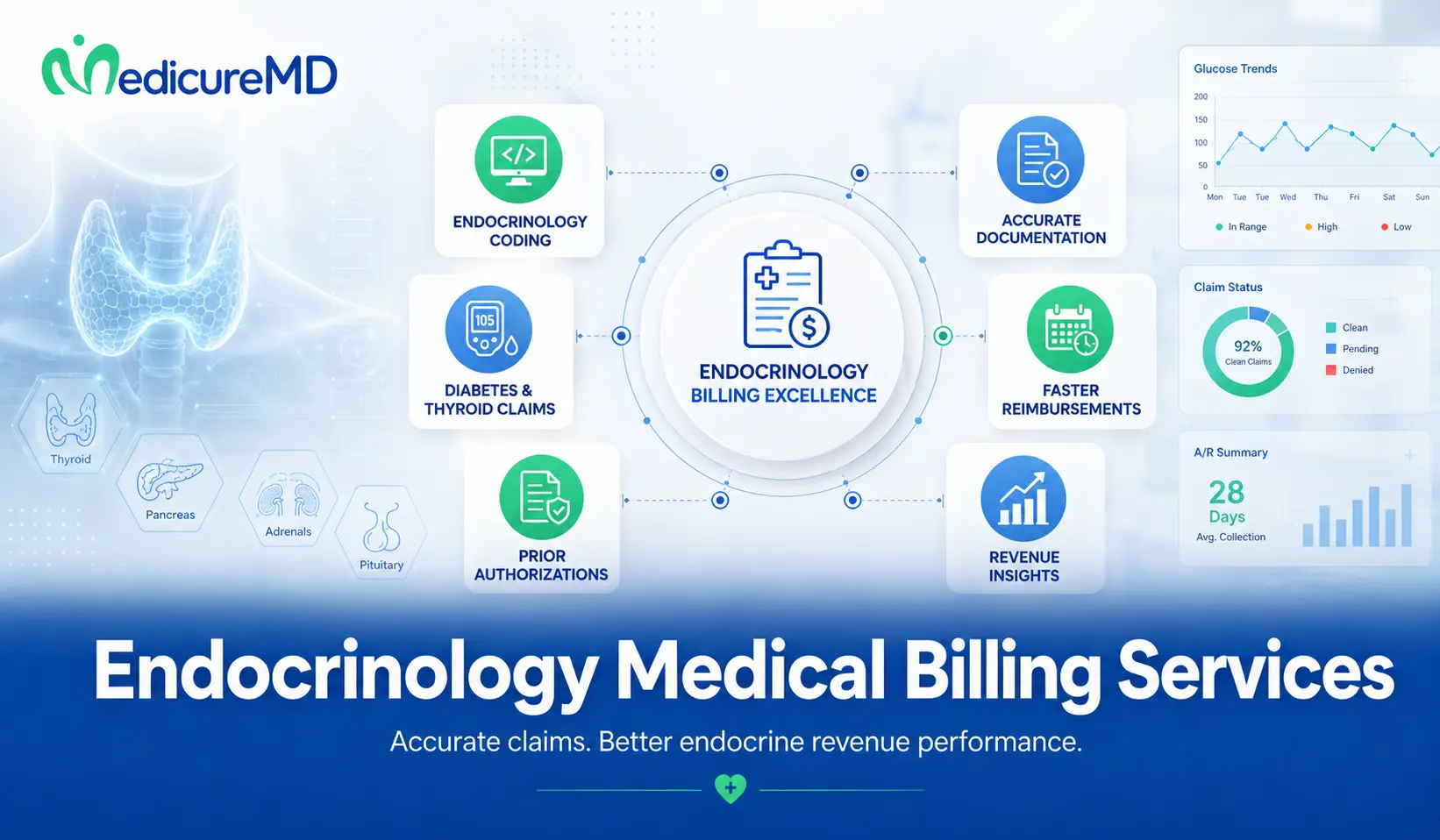
For that reason, endocrinology practices should treat billing as part of patient workflow rather than a final back-office task. Eligibility checks happen before care. Documentation happens during or after care. Coding follows the record. Claim status and denial work continue after submission.
How Do Endocrinology Billing Services Protect Practice Revenue?
Endocrinology billing services protect revenue by connecting specialty documentation with coding, claim submission, payer follow-up, and accounts receivable work. If the billing team understands diabetes technology and thyroid care, it can identify problems before those problems become 60-day unpaid balances. MedicureMD states that its endocrinology service covers claim tracking, denial management, coding, payer credentialing, and billing support for endocrine practices.
The process should start before the patient sees the physician. A practice can verify insurance and referral requirements before a scheduled visit. This matters when a patient receives an endocrine service that may require payer review or when the plan has changed since the last 3-month follow-up.
A specialty billing workflow should connect 4 core areas:
– Front-end billing: Verify active insurance, referrals, patient responsibility, and required authorization before the service.
– Charge and coding review: Match diabetes, thyroid, adrenal, metabolic, and other documented endocrine care with current codes.
– Claim and denial work: Submit claims then investigate rejections, denials, and requests for added documentation.
– A/R follow-up: Track unpaid claims by payer, age, dollar value, and next required action.
These steps should work as one cycle rather than 4 isolated departments. A front-desk eligibility mistake can become a payer denial 3 weeks later. A coding team that tracks the denial back to registration can help stop the same error from appearing on another 20 claims.
Diabetes technology creates another reason to choose specialty billing support. MedicureMD specifically identifies continuous glucose monitoring and insulin pump management among the areas that require detailed coding and documentation in endocrine practices. It also identifies diabetes education as part of the specialty billing environment.
CGM coverage offers a practical example. Medicare says it may cover a continuous glucose monitor when a beneficiary with diabetes takes insulin or has a history of qualifying hypoglycemia and meets the other coverage conditions. The healthcare provider must evaluate the patient before ordering the device. Review Medicare CGM coverage requirements.
Continued CGM coverage can also depend on ongoing documentation. Current CMS glucose-monitor policy states that after the initial CGM prescription there must be documentation every 6 months of an in-person or Medicare-approved telehealth visit for continued coverage of replacement supplies under the policy. A missed documentation cycle can create a billing problem even when the patient continues to need the device.
That relationship is simple: if Medicare coverage depends on documented follow-up, then the billing workflow must track the follow-up because the claim depends on that record. A billing team should flag the issue before a supply or related claim reaches payer review.
Prior authorization can create similar problems in endocrine care. Treatments and diagnostic services can face plan-specific requirements. The office should verify the exact payer rule before the service rather than assume that an authorization from last year still applies to the next treatment plan.
Revenue problems also appear when practices do not reconcile completed encounters. Imagine a 4-provider endocrine group completing 85 visits in one day. The EHR shows 85 closed encounters but the billing system receives only 81 charges. A daily reconciliation process can find those 4 missing encounters before they become forgotten revenue.
A/R work should follow the same discipline. An unpaid $40 laboratory-related balance and a larger physician claim should not always receive the same priority. Billing staff should review age and dollar amount. They should also look at appeal deadlines and payer behavior.
MedicureMD positions its endocrinology billing services around specialty coding and claims as well as denial appeals and payer-related workflows. The service page specifically names diabetes management, thyroid disorders, adrenal conditions, and other endocrine care as billing areas.
The practice should still keep clinical documentation under physician control. A billing company cannot create medical necessity that the record does not support. The stronger model gives the physician responsibility for clinical facts and gives the billing team responsibility for translating those facts into an accurate revenue cycle.
Medicare payment updates also deserve attention each year. For calendar year 2026, CMS established 2 Physician Fee Schedule conversion factors. The qualifying APM factor is $33.57 while the nonqualifying APM factor is $33.40. CMS also notes that geographic adjustments and RVUs affect final payment. Review the 2026 Medicare Physician Fee Schedule final rule.
The practical lesson for endocrinology groups is not to hard-code last year’s allowed amounts into a 2026 workflow. Medicare payment depends on the current schedule plus locality and service details. Commercial payers also follow their own contracts.
A billing team should compare expected payment with actual remittance. If a payer repeatedly pays $25 below the contracted amount on 40 similar claims, the practice could miss $1,000 before anyone notices the pattern.
This is also why outsourcing should mean more than sending claims. MedicureMD states that its endocrinology billing offering includes claim tracking and denial management alongside coding support. That model gives a practice a path to monitor what happens after the payer receives the claim.
Which Endocrinology CPT Codes Need the Most Attention?
Endocrinology CPT codes that need close attention include office E/M services, continuous glucose monitoring services, diabetes-related testing, and thyroid procedures. The correct code depends on what the physician or staff actually performed. It can also depend on device ownership and place of service. CMS claims data confirms that these code families appear in endocrinology practice patterns.
A short list can help physicians understand where billing errors may start:
– 99202–99205 and 99211–99215: Office and outpatient E/M code families used for new and established patient visits when applicable.
– 95249, 95250, and 95251: CGM-related services that can involve setup or monitoring work and professional interpretation depending on the service.
– **83036 and 82962:** Common diabetes-related testing codes for hemoglobin A1c and point-of-care glucose testing.
76536 and 10005/10006: Examples associated with head and neck ultrasound and ultrasound-guided fine-needle aspiration work that may appear in thyroid care.
CMS provider data shows endocrinologists billing services such as 99204, 99214, 83036, and 95251. Separate CMS records show endocrinology claims that include 76536 and 10005. These are examples of real Medicare service patterns rather than a promise that each code fits every patient or practice.
The office E/M family deserves special attention because many endocrine patients return for ongoing disease management. CMS references codes 99202–99205 and 99211–99215 within its office and outpatient E/M policy framework. The level selected must match the rules and the work documented for that encounter.
An endocrinologist treating one stable condition may document a different level of medical decision-making than a physician adjusting insulin after severe hypoglycemia while also reviewing multiple chronic complications. The code should reflect the actual encounter rather than a default template.
Time-based coding also requires an accurate record when the physician chooses time under applicable E/M rules. CMS data descriptions show common established-patient codes tied to different time thresholds when time drives selection. For example, CMS provider data lists 99214 as an established office visit associated with moderate medical decision-making or the applicable time threshold.
CGM billing requires even more attention because several codes can describe different parts of the workflow. CMS claims data shows 95250 for CGM monitoring with provider-supplied equipment and 95251 for CGM interpretation and report. CMS data also shows 95249 appearing in diabetes monitoring workflows.
The billing team should not assume that all 3 CGM codes belong on one encounter. The record should show which work occurred. Device ownership and data collection matter. Interpretation must also meet the requirements for the service reported.
Separate Medicare DME rules apply to the CGM device and supplies. Current CMS policy identifies HCPCS E2103 for certain non-adjunctive CGM devices that meet DME requirements and A4239 for the related supply allowance. CMS also sets modifier rules based on factors such as insulin treatment and device classification.
This creates an important entity relationship: CPT describes professional services while HCPCS may describe covered equipment or supplies. If a practice confuses professional interpretation with DME supply billing, the claim can follow the wrong payment path.
Three pre-billing checks can reduce avoidable endocrine claim problems:
– Confirm that the diagnosis and clinical note support the billed service for that date.
– Confirm that CGM or device-related work matches the professional code or DME pathway being reported.
– Confirm that required authorization and payer documentation exist before sending the claim.
– Confirm that place of service and any applicable modifier match the actual encounter.
These checks should happen before the claim becomes a denial. Correcting a missing field before submission may take 2 minutes. Reworking the same claim after a denial can require payer calls and corrected claims plus medical records.
Thyroid care creates another specialty coding challenge. CMS claims data for endocrinologists includes 76536 for head and neck ultrasound and 10005 for ultrasound-guided fine-needle aspiration of the first lesion. A practice should report only the service its documentation supports and should review current payer edits before combining related procedures.
MedicureMD’s endocrinology service page also identifies thyroid and parathyroid procedure coding as an area that needs specialty attention. It specifically calls out ultrasound-guided biopsy workflow and thyroid-related interpretation as billing challenges.
Diabetes-related laboratory work should follow a different payment workflow. CMS maintains the Clinical Laboratory Fee Schedule for many clinical diagnostic laboratory tests. In 2026, CMS also updated reporting timelines under the applicable laboratory payment framework. Endocrine practices that bill laboratory services should distinguish physician-fee-schedule services from CLFS services rather than treat every code as an office professional claim.
Diabetes self-management training creates another service path. Medicare Part B covers eligible outpatient diabetes self-management training when the patient has diabetes and a qualified provider orders the service. The practice should confirm who may furnish and bill the service under current Medicare rules before adding it to an endocrine program. citeturn5search0
Medical nutrition therapy also has its own provider and eligibility requirements. Medicare says eligible patients with diabetes can receive MNT when a doctor refers them. Medicare limits furnishing of covered MNT to a registered dietitian or another nutrition professional who meets the applicable requirements.
This is why endocrinology billing should not rely on one generic superbill. A diabetes center may deliver E/M care and CGM interpretation as well as education and nutrition services. Each service can have a different provider rule or code family.
Modifiers create another point of review. A modifier should explain a real billing circumstance. It should not function as a universal denial fix. The billing team needs to understand why the modifier applies before attaching it to an endocrine claim.
The same principle applies to G2211 when Medicare requirements support it. CMS describes G2211 as a visit-complexity add-on connected with certain office and outpatient E/M services and ongoing care relationships. CMS claims data shows endocrinologists reporting G2211 alongside ongoing endocrine care. Practices should follow current CMS edits rather than add the code to every chronic disease encounter.
CMS has also issued a 2026 update concerning edits for G2211 with an implementation date of October 5, 2026. Because that date is still ahead of August 12, 2026, practices should review the rule before October claims rather than assume today’s edit logic will remain unchanged.
Accurate coding therefore requires both current rules and a current clinical record. An EHR template from 2024 should not become the final authority for a claim in 2026. The billing team should verify current CMS and payer guidance when a policy changes.
MedicureMD states that its coders specialize in endocrinology CPT and ICD-10 workflows. It also lists claim tracking and payer compliance work as part of its specialty service. Practices considering outsourced billing can review MedicureMD’s endocrinology medical billing services to compare those functions with their current internal workflow.
The strongest outsourcing decision starts with numbers. Review 90 days of claims. Separate E/M denials from CGM and thyroid-related claims. Then measure how many accounts needed corrected coding or missing documentation.
For example, a practice may discover that its overall denial rate looks manageable while 18 of 60 CGM-related claims required rework. That service-specific finding gives the practice a better action plan than one blended practice-wide percentage.
Next review charge lag. A provider can document correctly while revenue still slows if the charge waits 5 days before billing. Specialty billing support should shorten avoidable handoffs without asking physicians to rush incomplete documentation.
Then review A/R by payer. A commercial plan may account for 15% of visits but 35% of balances over 90 days. That difference tells administrators where payer follow-up may need more attention.
Finally, review underpayments. A paid claim is not always a correctly paid claim. The billing team should compare remittance against applicable contract terms and current Medicare payment data when appropriate.
Frequently Asked Questions About Endocrinology Billing and Coding
What Is Endocrinology Medical Billing?
Endocrinology medical billing is the revenue cycle process for endocrine visits and related services. It can include diabetes care and CGM work as well as thyroid services and other hormone-related care. The billing team converts documented services into claims then tracks payment and denials. MedicureMD offers this support for solo endocrinologists and larger endocrine programs.
What Does Endocrinology Billing and Coding Include?
Endocrinology billing and coding includes code selection, claim review, submission, denial follow-up, and payment tracking for endocrine care. A typical practice may bill E/M visits and diabetes testing as well as CGM interpretation or thyroid procedures. The exact workflow depends on the documented service and payer policy for that patient.
Which Endocrinology CPT Codes Are Commonly Used?
Common endocrinology CPT codes include office E/M and diabetes-monitoring code families. CMS claims data for endocrinologists shows examples such as 99204 and 99214 as well as 83036 and 95251. Thyroid-focused practices may also report services such as 76536 or ultrasound-guided FNA codes when the documented service supports them.
Can Endocrinology Billing Services Handle CGM Claims?
Endocrinology billing services can support professional CGM claims and related documentation workflows when the contracted service includes them. Medicare applies separate requirements to certain CGM equipment and supplies. Current CMS policy also ties continued supply coverage to documented follow-up. Practices should confirm the billing team understands both professional and DME-related pathways.
When Should an Endocrinology Practice Outsource Billing?
An endocrinology practice should consider outsourcing when denials, charge lag, or old A/R repeatedly exceed the staff’s available billing capacity. A 5-provider office should first review 90 days of claims by service type. If CGM or thyroid claims require repeated corrections, a specialty billing team may provide a more focused workflow.
Your next step should start with data rather than a contract. Pull 90 days of endocrinology claims and identify the 3 service groups creating the most rework. Measure missing charges and denials. Then review A/R over 90 days and compare expected payment with actual payment.
Separate diabetes technology from standard office visits during that review. A practice may discover that routine E/M claims move correctly while CGM documentation creates most of the delays. Another group may find that thyroid procedure claims need stronger coding review.
Then decide which problem belongs to the physician and which belongs to the billing workflow. Physicians should document the medical work they performed. Billing staff should turn that record into an accurate claim and pursue the account after submission.
MedicureMD’s current endocrinology offering focuses on diabetes management and thyroid care as well as endocrine coding and denial work. Its service page also describes claim tracking and payer credentialing support. That makes MedicureMD endocrinology medical billing services a commercial option for practices that want specialty billing support without shifting clinical work away from physicians.
Endocrinology reimbursement will keep changing as Medicare updates payment policy and diabetes technology becomes a larger part of patient care. Practices that review codes and payer rules before claims age will have better control over revenue. Start with the highest-value billing problem now, assign one owner to fix it, and measure the same claim category again after the next 30 to 90 days.