

Denial Management Services: How Medical Practices Recover Revenue
Denial management services identify rejected or denied healthcare claims then correct each issue and recover payment while preventing the same error from returning.
A denied claim is not only a billing problem. It is a signal that one part of the patient-to-payment process failed. The cause may begin at registration. It may appear during coding. It may also come from a payer rule that changed after the service date.
If a practice treats every denial as a one-time event then staff will repeat the same repair work each week. A structured denial program links each denial to its root cause. It also assigns an owner and tracks the result. That approach protects current revenue and lowers future rework.
For physicians and administrators the main goal is clear. Claims should enter the payer system with correct patient data. They should also contain valid codes and required records. When a payer still denies payment the team must respond before the appeal or filing deadline expires.
What Are Denial Management Services?
Denial management services are organized billing activities that classify claim failures and recover valid reimbursement. The work starts when a clearinghouse rejects a claim or a payer issues a negative payment decision. It ends when the claim is paid or closed with a documented reason.
The service usually covers claim review. It also covers correction and appeal work. A skilled team reads payer messages and remittance codes. It compares the decision with the medical record and the payer policy. It then chooses the correct next step instead of resubmitting the same claim without a change.
The process also feeds information back to the source department. If the denial came from expired coverage then registration needs the finding. If it came from missing medical necessity language then the clinical documentation process needs a fix. This relationship turns denial management into denial prevention.
Why Are Healthcare Claim Denials Increasing?
Healthcare claim denials are increasing because payer edits are changing faster and documentation demands are growing. Practices also face more plan rules. These include prior authorization and referral requirements. Even one missing field can delay payment for weeks.
HFMA reported that denial rates averaged close to 12% in 2025. That level means about 120 of every 1,000 claims may need added work before payment. The full finding appears in HFMA’s 2026 review of denial trends.
MGMA found a similar pressure point in January 2026. In a poll with 288 applicable responses 48% of medical group leaders named denials and appeals as their biggest revenue cycle leak. Front-end issues came second at 23%. The MGMA revenue cycle findings show why practices need both prevention and recovery.
Most denials fall into a small set of operational categories:
- Coverage denials: inactive insurance or a coordination of benefits issue blocks payment.
- Authorization denials: the service lacks an approval number or falls outside an approved date range.
- Coding denials: the payer rejects a code pair or modifier or unit count.
- Documentation denials: the record does not support medical necessity or the billed service level.
The categories help teams assign work fast. They also expose patterns. If one location produces most eligibility denials then the problem likely begins before the visit. If one payer denies the same code pair then the team should review that payer’s current policy.
What Is the Difference Between a Claim Rejection and a Denial?
A claim rejection happens before payer adjudication while a denial happens after the payer processes the claim. This difference changes the response. A rejected claim usually needs a data or format correction. A denied claim may require a corrected claim or a formal appeal.
For example a clearinghouse may reject a claim because the subscriber ID has an invalid character. The payer never receives that claim. Staff should correct the ID and submit it again. The timely filing clock still matters because the rejected file may not count as accepted by the payer.
A denial follows a payer decision. The payer may state that the service lacked authorization or medical necessity. Staff must review the explanation of benefits or electronic remittance advice. They must then compare the reason with the record and contract before choosing an appeal path.
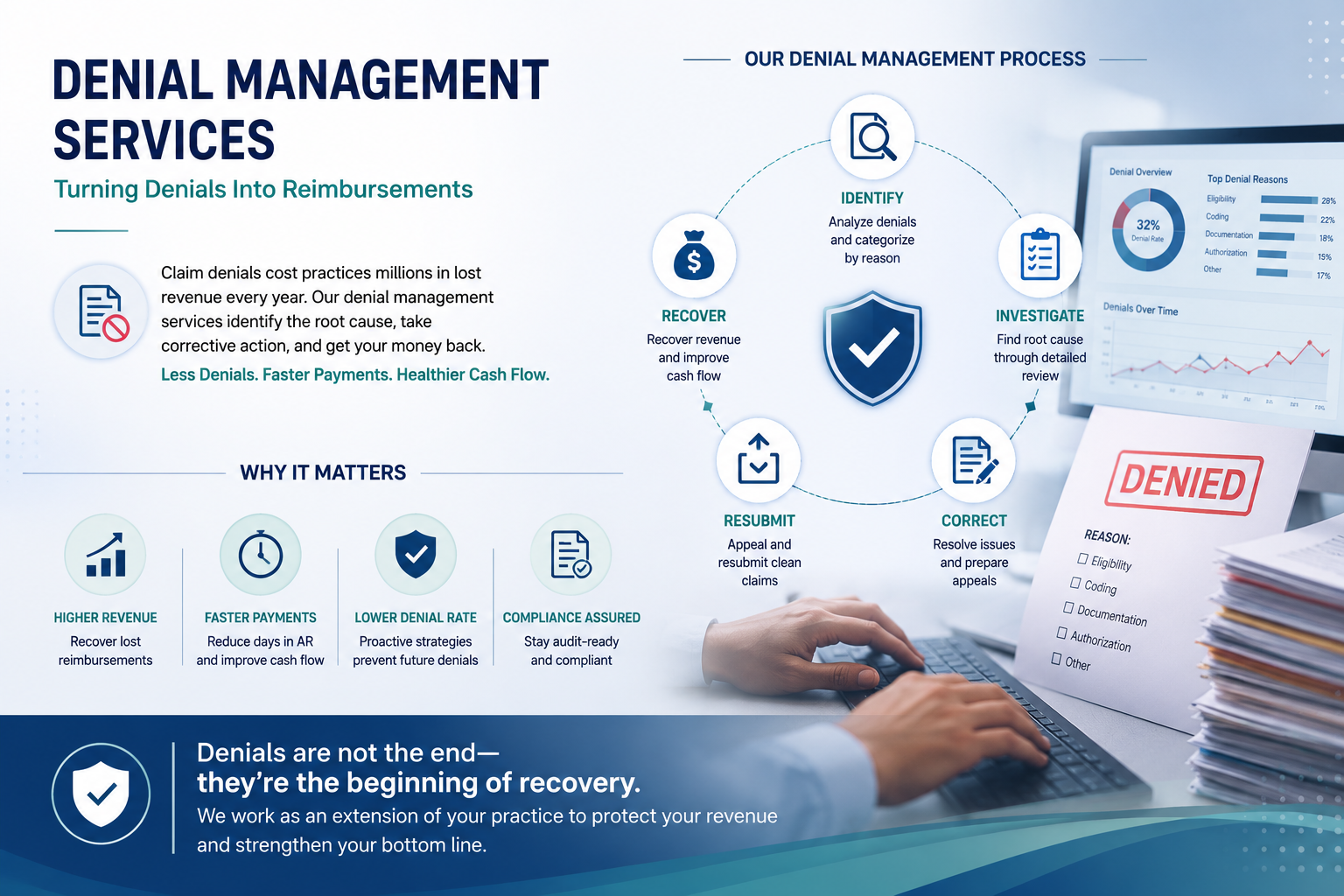
How Does the Denial Management Process Work?
The denial management process moves through detection and classification before correction and prevention. Each step should have a deadline and an assigned owner. Without those controls claims can remain in an aging report until recovery becomes unlikely.
A practical process uses four connected stages:
- Triage: identify the payer reason and the amount at risk within 24 to 48 hours.
- Validation: compare the claim with the record and payer policy.
- Resolution: correct the claim or submit an appeal with supporting proof.
- Prevention: send the root cause to the team that can stop a repeat denial.
Priority rules keep staff focused on recoverable value. A $5,000 surgical denial with a 15-day appeal window needs faster action than a $25 balance with 90 days remaining. The team should weigh the amount and deadline. It should also consider the chance of recovery and the evidence available.
Documentation should follow every action. The account note should show the denial date and reason. It should show the person contacted and the reference number. It should also state the next follow-up date. Clear notes stop two staff members from repeating the same call.
How Does Hospital Denial Management Differ From Physician Billing?
Hospital denial management handles larger claims and more complex records than most physician billing workflows. A hospital claim may include room charges and procedures. It may also involve implants and pharmacy items. One denial can place thousands of dollars at risk.
Hospital teams often separate clinical denials from technical denials. A clinical denial challenges medical necessity or level of care. A technical denial may involve registration or coding. It may also involve authorization or timely filing. Each path needs different evidence and staff knowledge.
If an inpatient claim is denied for level of care then billing staff alone cannot resolve it. The appeal may need a physician advisor and a case review note. It may also need the admission order and progress notes. Hospital denial management links clinical evidence with the payer response.
Prior authorization adds another layer. The AMA reported in 2026 that physicians and staff complete about 40 prior authorization requests per physician each week. The work takes about 13 hours. Nearly one-third of physicians said requests are often or always denied. These findings appear in the AMA prior authorization survey summary.
What Do Accounts Receivable Claim Denial Management Services Cover?
Accounts receivable claim denial management services work unpaid claims that already sit in A/R. The team segments balances by payer and age. It also groups them by denial reason. This structure helps staff recover high-value claims before appeal rights expire.
A/R follow-up should not begin with random payer calls. Staff should first confirm that the payer accepted the claim. They should then check claim status and remittance details. If the payer asked for records the team should send the correct documents through the required channel.
Older claims need a different strategy. A claim at 31 days may only need a status check. A claim at 121 days may need escalation or proof of earlier submission. If the timely filing limit passed then the team should look for evidence that the payer received the original claim on time.
Good A/R denial work also identifies underpayments. A payer may process a claim but pay below the contracted amount. That account is not a full denial. It still needs contract review and follow-up because small payment gaps can grow across hundreds of encounters.
How Do Denial Management Services Prevent Repeat Denials?
Denial management services prevent repeat denials by turning payer responses into workflow changes. A corrected claim recovers one payment. A root-cause fix can protect every later claim with the same risk.
Prevention work should focus on four control points:
- Registration controls: verify demographics and active coverage before the visit.
- Authorization controls: match approved codes and dates with the planned service.
- Documentation controls: capture the medical facts needed to support the billed work.
- Claim controls: check codes and modifiers against payer edits before submission.
Each control needs a feedback loop. If a payer denies 18 claims for one missing modifier then the coding team should receive the examples. The claim edit should also change. Training alone may fail if the billing system still allows the same error.
The same rule applies to dental and medical crossover claims. A dental office may need radiographs and treatment notes for a complex procedure. Some oral surgery claims may also require medical codes and diagnosis support. Practices can review dental medical billing services when claim rules cross both benefit types.
Which Denial Management Metrics Should a Practice Track?
A practice should track initial denial rate and overturned denial rate along with denial aging and write-offs. These measures show whether errors start before submission and whether the team recovers payment after a denial.
Initial denial rate measures claims denied on the first payer decision. A rising rate points to a front-end or claim-quality problem. The team should review it by payer and provider. It should also review the rate by location and denial category.
Overturned denial rate shows how many denied claims become paid after correction or appeal. A low rate may mean staff are appealing weak cases. It may also mean they are missing records or deadlines. A high rate may reveal that payer decisions are often incorrect.
Time to appeal is another useful measure. If the average denial sits for 20 days before staff act then the practice loses recovery time. A 48-hour triage target helps protect appeal windows. The target also exposes staffing gaps before claims reach older A/R buckets.
When Should a Practice Outsource Denial Management?
A practice should consider outsourced denial management when unresolved claims exceed internal staff capacity or repeat causes remain unchanged. Warning signs include growing A/R over 90 days and missed appeals. Another sign is frequent payer follow-up without clear account notes.
Outsourcing works best when the practice keeps shared accountability. Physicians still need to document the service. Front-desk staff still need to collect correct insurance information. The outside team should manage claim research and appeal work. It should also report the root causes that require practice action.
Before signing an agreement the practice should define the scope. It should ask whether the service covers clearinghouse rejections and corrected claims. It should also confirm whether clinical appeals and underpayments are included. Old A/R needs a clear start date and fee structure.
MedicureMD connects denial work with wider dental medical billing services . This connection matters because denials often start before the claim reaches the payer. Prevention needs access to registration and coding patterns as well as payment data.
How Should a Practice Evaluate Denial Management Services?
A practice should evaluate denial management services by workflow depth and reporting quality rather than price alone. The service should show who works each denial and when. It should also show why the denial happened and how much money was recovered.
Ask how the team handles payer deadlines. A clear answer should cover daily work queues and escalation rules. It should also cover clinical documentation requests and appeal evidence. Vague promises may hide a process that only resubmits corrected claims.
Review sample reports before the contract starts. The report should separate rejections from denials. It should separate preventable denials from payer errors. It should also show top causes and recovery by payer. These fields support action rather than simple account counts.
Security and access also need written controls. Staff should receive only the access needed for their tasks. User activity should remain traceable. The business associate agreement should define protected health information duties and breach response.
Frequently Asked Questions About Denial Management
What Is Denial Management in Medical Billing?
Denial management is the process of finding and resolving claims that a payer rejected or denied. The team identifies the reason and checks the claim against the record. It then corrects the error or files an appeal. The final step sends the root cause back to registration or coding so the issue does not repeat.
What Is the Main Goal of Denial Management Services?
The main goal of denial management services is to recover valid payment and reduce future claim failures. Recovery focuses on current unpaid revenue. Prevention focuses on the workflow that caused the denial. Both goals matter because repeated corrections raise labor costs and delay cash even when the claim pays later.
How Fast Should a Denied Claim Be Reviewed?
A denied claim should usually enter triage within 24 to 48 hours after the payer response. Early review protects appeal deadlines and helps staff request missing records while the encounter remains recent. High-value denials or claims with short filing limits should move ahead of lower-value accounts with longer response periods.
Can Every Denied Claim Be Appealed?
Not every denied claim should be appealed. A claim needs a valid payment basis and enough evidence to support the billed service. Some denials need a corrected claim instead. Others may be nonrecoverable because the filing limit passed without proof of timely submission. Staff should choose the action after reviewing policy and records.
What Causes Most Preventable Claim Denials?
Most preventable claim denials begin with inactive coverage or missing authorization. Coding and modifier errors also create repeat failures. Documentation gaps create another large group. A denial report should connect each cause to the responsible workflow because one general denial rate cannot show where the practice should act.
How Do Denial Management Services Improve Cash Flow?
Denial management services improve cash flow by shortening the time between a negative payer decision and the next valid action. Fast correction moves eligible claims back into processing. Root-cause reporting also lowers the number of later denials. The practice receives more payment without depending only on higher patient volume.
What Should Your Practice Do Next?
Your practice should begin with a 90-day denial review that connects lost revenue with the workflow that caused it. Measure the initial denial rate and A/R over 90 days. Then identify the top three denial reasons by payer and dollar value.
Assign one owner to each cause. Set a response target for new denials. Update front-end checks and claim edits where patterns appear. Review progress every month so staff can see whether the denial rate and recovery time are moving in the right direction.
Payer rules will continue to change. Practices that build faster feedback loops will respond before old problems spread across hundreds of claims. A structured denial program gives physicians and administrators a direct path to protect revenue and reduce avoidable billing work.