
Days in Accounts Receivable: Formula, Benchmark and How to Reduce It
By MedicureMD Billing Team. Reviewed by an AAPC-certified coder.
Days in accounts receivable (also called A/R days) tells you how long it takes your practice to get paid after you provide care. A low number means money comes in fast. A high number means claims are stuck, denied or forgotten. This guide explains days in accounts receivable in plain language: the formula, a worked example, what a good number looks like and 7 ways to bring it down.
What Are Days in Accounts Receivable?
Days in accounts receivable is the average number of days it takes to collect payment on your claims and patient balances. It is one of the first numbers a billing team looks at, because it shows the health of your whole revenue cycle in one figure.
If your days in accounts receivable keep rising, it usually means claims are being sent late, denied or not followed up. The earlier you spot it, the less money you lose.
Days in Accounts Receivable Formula
The formula is:
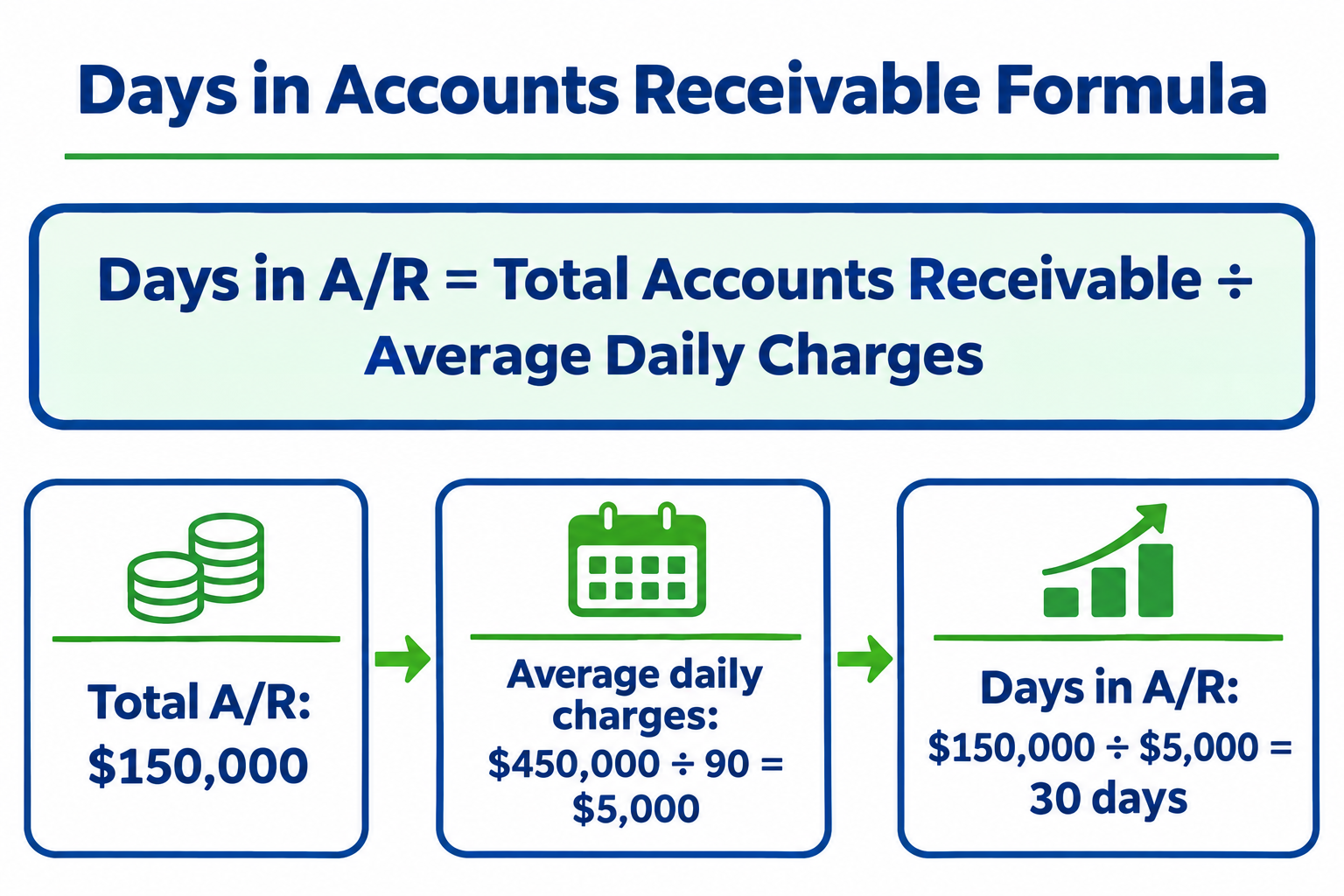
Average daily charges are your total charges over a period (usually 90 days) divided by the number of days in that period.
How to Calculate Days in Accounts Receivable
- Find your total A/R. Pull this from your billing system. It is the total of all unpaid claims and patient balances today.
- Find your total charges for the last 90 days. This is what you billed, not what you collected.
- Divide the charges by 90. This gives your average daily charges.
- Divide total A/R by average daily charges. The result is your days in accounts receivable.
Example: Your total A/R is $150,000 and you billed $450,000 in the last 90 days. Your average daily charges are $450,000 ÷ 90 = $5,000. Your days in accounts receivable are $150,000 ÷ $5,000 = 30 days. (These numbers are only an example.)
What Is a Good Number for Days in Accounts Receivable?
Many medical practices aim for roughly 30 to 40 days, and numbers well above that are often a warning sign. The right target depends on your specialty and payer mix, so compare yourself with benchmarks from sources such as MGMA and track your own trend over time. A number that is rising month after month matters more than any single figure.
Also look at your A/R aging report, which splits unpaid claims into buckets: 0 to 30 days, 31 to 60, 61 to 90 and over 90. The older a claim gets, the harder it is to collect.
Why Days in Accounts Receivable Goes Up
- Claims are sent late or with errors
- Eligibility and prior authorization are not checked before the visit
- Denials are not worked quickly, or not at all
- Nobody follows up on unpaid claims
- Payments are posted late
- Patient balances are not collected at the time of the visit
7 Ways to Reduce Days in Accounts Receivable
1. Check eligibility before every visit
Confirm coverage, copays and deductibles up front, so claims are not rejected for coverage problems.
2. Send clean claims quickly
Scrub claims for errors before sending them and submit them soon after the visit. Our guide to the medical billing process shows where claims usually break down.
3. Work denials right away
Find the reason for each denial, fix it and appeal before the filing deadline. Our denial management services are built for this.
4. Follow up on unpaid claims on a schedule
Do not wait for payers. Check claim status regularly, starting with the oldest.
5. Review your A/R aging report every week
Weekly review catches slow payers and old claims before they become write-offs.
6. Post payments quickly and check them
Post payments daily and compare them with your contracted rates, so underpayments are caught.
7. Collect patient balances at the visit
Collect copays at check-in and send clear patient statements for the rest.
When to Get Help With Accounts Receivable
If your A/R keeps growing and your team does not have time to chase claims, an outside team can take it on. Our medical A/R management services follow up on unpaid claims until they are paid, and you get a report every week. MedicureMD is a U.S.-based team of AAPC-certified coders and billers serving 500+ physicians across 30+ specialties, with no long-term contract, only 30 days notice. Start with a free billing audit and get a written report within 24 to 48 hours.
Frequently Asked Questions About Days in Accounts Receivable
What does days in accounts receivable mean?
It is the average number of days it takes your practice to collect payment after providing care. A lower number means you get paid faster.
How do you calculate days in accounts receivable?
Divide your total accounts receivable by your average daily charges. Average daily charges are total charges over a period, such as 90 days, divided by the number of days.
What is a good days in accounts receivable number?
Many practices aim for about 30 to 40 days, but the right target depends on your specialty and payers. A rising trend is a warning sign.
How can I reduce days in accounts receivable?
Check eligibility before visits, send clean claims quickly, work denials right away, follow up on unpaid claims, review your aging report weekly, post payments fast and collect patient balances at the visit.
Can a billing company help lower my A/R days?
Yes. A billing team can send cleaner claims, work denials and follow up on every unpaid claim, which is the work that brings A/R days down.